Sunday, March 12, 2017
Stratton Brook Hut
Today we hiked to Stratton Brook Hut in western Maine near Sugarloaf Mountain. It was a beautiful sunny day, if cold (about 10 F) and windy. The photo above is near the beginning of the hike and shows the Bigelow Range in the background. The photo below is the hut:
Stratton Brook Hut is one of four huts constructed in western Maine in 2008-2012 by Maine Huts and Trails. There may be more huts in the future according to Wikipedia. These are very nice huts, as shown in the photo below. Stratton Brook Hut can sleep 44 people in 10 bunkrooms. We bought lunch at the hut and it was delicious.
Below is the Bigelow Range from a lookout near the hut:
The trailhead for our hike was on ME-27 just north of Sugarloaf Mountain Resort. It was a three mile hike in to the hut on a groomed trail – see photo below:
We saw cross-country skiers, snowshoers (but snowshoes weren't necessary), and fat tire bicycle riders. Motorized vehicles are not allowed except for a snowmobile for the hut crew. Western Maine received heavy snowfalls in February. There had since been warm weather which consolidated that snow, but there was still a lot of snow left – about 1.5 feet of very solid snow in the woods.
When friends and I were winter peakbagging in 1984-1992 there were no trails or huts like these in the woods! We climbed the two Bigelow peaks (Avery Peak and West Peak) on March 7, 1985 on our way home from a multi-day trip to Baxter State Park where we had climbed North Brother.
Wednesday, February 8, 2017
The Switchel Philosopher
Introducing my new blog:
The Switchel Philosopher
In retirement my goal is to spend time traveling in both the physical world and the world of ideas, looking for adventures to blog about. This blog will continue, and here I will blog about my travel adventures in the physical world, such as the recent road trip to Florida that Nancy and I did. "The Switchel Philosopher" will be for adventures in the world of ideas, starting with thoughts about government and citizenship.
I assume that anyone reading this blog knows what switchel is, but if not see the About page on "The Switchel Philosopher."
The Switchel Philosopher
In retirement my goal is to spend time traveling in both the physical world and the world of ideas, looking for adventures to blog about. This blog will continue, and here I will blog about my travel adventures in the physical world, such as the recent road trip to Florida that Nancy and I did. "The Switchel Philosopher" will be for adventures in the world of ideas, starting with thoughts about government and citizenship.
I assume that anyone reading this blog knows what switchel is, but if not see the About page on "The Switchel Philosopher."
UPDATE: See also My Blogging History on "The Switchel Philosopher."
Tuesday, February 7, 2017
Home Again
We are home again after our 3+ week road trip to Florida. It was a great trip, but it's good to be home. We arrived yesterday afternoon to about 5" of snow on the ground. We got another 3" or so overnight. The photo is from our back door this morning.
Saturday, February 4, 2017
Planters Inn
On our way home from Florida, we stayed last night at the Planters Inn (photo above). This site in Savannah, Georgia, has a rich history.
Savannah, the oldest city in Georgia, was founded in 1733 by James Oglethorpe. Savannah is known as America's first planned city, having been built around "squares" (see Oglethorpe Plan). The Planters Inn is on Reynolds Square, named for John Reynolds, colonial governor of Georgia from 1754 to 1757. The statue in Reynolds Square, however, is not of Mr. Reynolds, but of John Wesley.
John Wesley arrived in Savannah in February 1736 at the request of James Oglethorpe to head the new parish there (Church of England, of course). Mr. Wesley stayed less than two years in Savannah. He returned to England in December 1737 following a failed love affair. The reason that there is a statue of John Wesley in Reynolds Square is that back in England he founded Methodism (i.e., the Methodist church). See the Wikipedia entry for John Wesley for more info. It's an interesting story, but it is not the story of the Planters Inn.
It is thought that John Wesley's church and parsonage in Savannah were approximately where the Planters Inn is now. The original buildings were lost in a disastrous fire in 1796 that destroyed much of the city. In the early 1800s two mirror-image homes were constructed on the site, belonging to business partners Oliver Sturges and Benjamin Burroughs. The Sturges House remains today. It was purchased by the Morris Newspaper Corporation in 1971, renovated, and made into their headquarters. The Burroughs house deteriorated and was eventually demolished. The John Wesley Hotel was built in its place, and became the Planters Inn in 1984.
The photo above shows the Sturges House to the right of and adjacent to the (much larger) Planters Inn.
Howard Duchacek and Sue Wisehart told us about the Planters Inn and recommended it to us. It was a good choice!
Friday, February 3, 2017
422 Ohio Street
Nancy's grandparents' home at 422 Ohio Street in St. Cloud, Florida, will go on the market later this month (photo above). Note the Vermont car in the driveway. It even has winter tires on!
The real estate agent is Jennifer Davis.
The other sides of the house:
And one last view of the carport without the car:
We left Florida today.
Thursday, February 2, 2017
Siesta Key
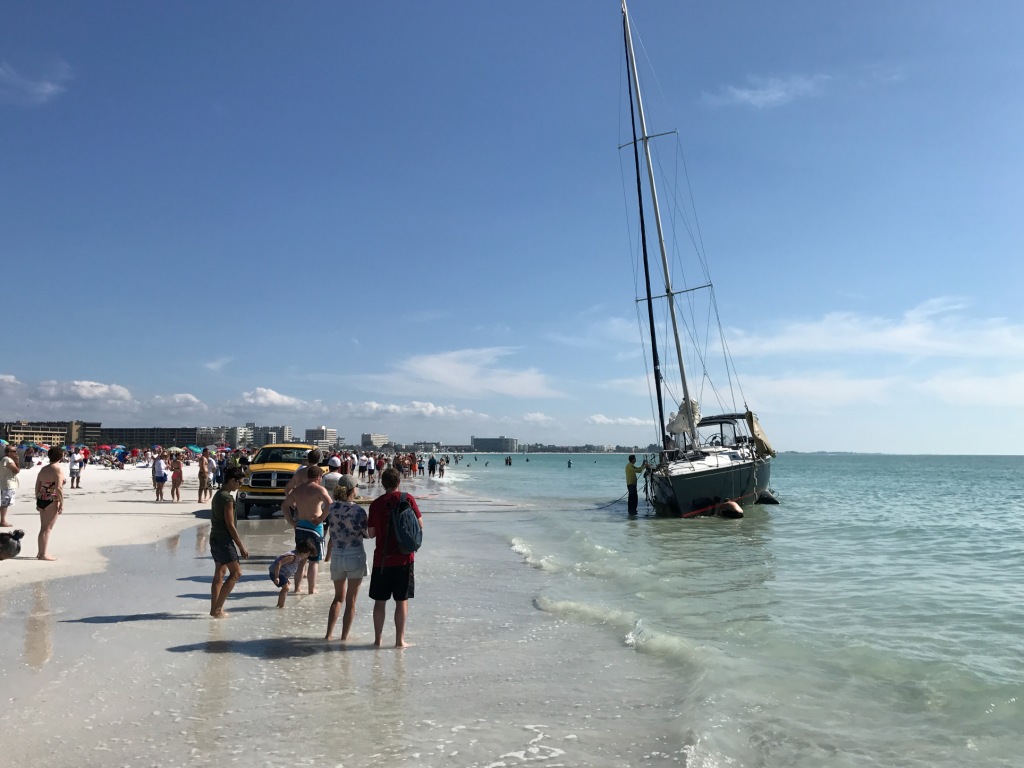
Today we visited our friends Howard Duchacek and Sue Wisehart in Siesta Key on the Gulf Coast of Florida, just south of Sarasota. We took long, delightful walks on the beach (photo above) where one of the interesting sights was a sailboat that had run aground:
The beach on Siesta Key is said to have the "whitest and finest sand in the world." It was very pleasant to walk on. We saw people parasailing and flying lightweight seaplanes. Howard and I enjoyed swimming in the ocean, but Nancy and Sue declined the opportunity.
Siesta Key has beautiful sunsets. Howard says they often see the green flash. No green flash today, but there was a lovely sunset:
Tuesday, January 31, 2017
Lake Tohopekaliga
St. Cloud is on East Lake Tohopekaliga. Nearby Lake Tohopekaliga is about twice as large. Today we went on an airboat ride on Lake Tohopekaliga at Wild Willy's Airboat Tours.
The airboat had room for six passengers but it was just Nancy, me and Captain Brandon, who gave a great tour. It was a beautiful day, warm and sunny, and we saw lots of wildlife including a nest of baby alligators and several adult alligators, such as this one:
Alligators are common in Florida and Louisiana. They are native only to the United States and China (where they are endangered). Crocodiles, on the other hand, are native to Africa, Asia, the Americas, and Australia. Click here for the differences between crocodiles and alligators. Crocodiles tend to prefer saltier water than alligators. Southern Florida is the only place in the world where crocodiles and alligators live side by side, but on Lake Tohopekaliga in central Florida there are only alligators. Both alligators and crocodiles are commercially farmed.
We also saw many birds including an osprey and a pair of bald eagles and their nest, and bass spawning grounds. Lake Toho, as it is called, is popular for bass fishing.
Back at Wild Willy's office, Nancy got to hold a baby alligator:
Wednesday, January 25, 2017
Humans in Space - What Next?
The last time NASA launched a human into space was July 2011, the final launch of the Space Shuttle. What's next?
Humans are still in space, of course. Two Chinese astronauts spent a month in space last fall (link), and the International Space Station (ISS) has been continuously crewed since 2000. The Space Shuttle was instrumental in building the ISS, but crews are now transported to and from the ISS solely via Russian Soyuz rockets.
NASA is currently developing the Space Launch System (SLS) (Wikipedia, NASA) which will reuse concepts from the Space Shuttle. Like the Space Shuttle, it will have solid rocket fuel boosters and the first stage will be similar to the external fuel tank on the shuttle. Unlike the Space Shuttle, it will eventually have a second stage and the payload will not be a winged craft that returns to Earth like an airplane.
Every Space Shuttle launch included crew. The SLS will be capable of launching both crewed and uncrewed payloads. For crewed missions, NASA is developing the Orion spacecraft (Wikipedia, NASA). Orion is similar to Apollo but will hold up to six astronauts.
The first uncrewed launch of the SLS is presently scheduled for late 2018. The first crewed launch is not likely to occur before 2021. The SLS will have a launch capacity similar to the Saturn V, and NASA believes that it puts it on a path to launch crewed missions to Mars in the 2030s.
The image above shows the main elements of NASA's Space Launch System.
In addition to national space programs, several private companies are also developing crewed spaceflight capabilities.
SpaceX has had more than 30 successful space launches, including nine resupply missions to the ISS. From the company website: "SpaceX designs, manufactures and launches advanced rockets and spacecraft. The company was founded in 2002 to revolutionize space technology, with the ultimate goal of enabling people to live on other planets." All missions to date have been uncrewed, but SpaceX is developing the capability to send crews to the ISS. Crewed missions will be launched from Kennedy Space Center in Florida. SpaceX was founded by Elon Musk (PayPal, Tesla, SolarCity) and is privately owned.
Blue Origin is developing reusable rockets with the goal of "millions of people living and working in space." They have had several successful uncrewed suborbital launches, and are planning crewed suborbital launches, particularly for space tourists, beginning in 2017 or 2018. To date their launches have been from Texas, but they recently announced plans to launch orbital missions from Cape Canaveral Air Force Station, adjacent to the Kennedy Space Center. Blue Origin was founded by Jeff Bezos (Amazon, Washington Post) and is privately owned.
Virgin Galactic is also developing suborbital launch capabilities for space tourists with the goal of being the "the world's first spaceline." The Ansari X Prize was a private $10 million prize created in 1996 for the first non-governmental organization to successfully launch a reusable crewed suborbital spacecraft twice within two weeks. The prize was won in 2004 by SpaceShipOne designed by Burt Rutan and funded by Paul Allen (Microsoft). Virgin Galactic licensed their technology and started development of a second-generation spacecraft for commercial ventures: SpaceShipTwo. Virgin Galactic is part of the Virgin Group, a United Kingdom conglomerate founded by Sir Richard Branson.
For reference, two non-governmental organizations in the U.S. that are important for developing uncrewed space missions are United Launch Alliance and Orbital ATK.
Humans are still in space, of course. Two Chinese astronauts spent a month in space last fall (link), and the International Space Station (ISS) has been continuously crewed since 2000. The Space Shuttle was instrumental in building the ISS, but crews are now transported to and from the ISS solely via Russian Soyuz rockets.
NASA is currently developing the Space Launch System (SLS) (Wikipedia, NASA) which will reuse concepts from the Space Shuttle. Like the Space Shuttle, it will have solid rocket fuel boosters and the first stage will be similar to the external fuel tank on the shuttle. Unlike the Space Shuttle, it will eventually have a second stage and the payload will not be a winged craft that returns to Earth like an airplane.
Every Space Shuttle launch included crew. The SLS will be capable of launching both crewed and uncrewed payloads. For crewed missions, NASA is developing the Orion spacecraft (Wikipedia, NASA). Orion is similar to Apollo but will hold up to six astronauts.
The first uncrewed launch of the SLS is presently scheduled for late 2018. The first crewed launch is not likely to occur before 2021. The SLS will have a launch capacity similar to the Saturn V, and NASA believes that it puts it on a path to launch crewed missions to Mars in the 2030s.
The image above shows the main elements of NASA's Space Launch System.
In addition to national space programs, several private companies are also developing crewed spaceflight capabilities.
SpaceX has had more than 30 successful space launches, including nine resupply missions to the ISS. From the company website: "SpaceX designs, manufactures and launches advanced rockets and spacecraft. The company was founded in 2002 to revolutionize space technology, with the ultimate goal of enabling people to live on other planets." All missions to date have been uncrewed, but SpaceX is developing the capability to send crews to the ISS. Crewed missions will be launched from Kennedy Space Center in Florida. SpaceX was founded by Elon Musk (PayPal, Tesla, SolarCity) and is privately owned.
Blue Origin is developing reusable rockets with the goal of "millions of people living and working in space." They have had several successful uncrewed suborbital launches, and are planning crewed suborbital launches, particularly for space tourists, beginning in 2017 or 2018. To date their launches have been from Texas, but they recently announced plans to launch orbital missions from Cape Canaveral Air Force Station, adjacent to the Kennedy Space Center. Blue Origin was founded by Jeff Bezos (Amazon, Washington Post) and is privately owned.
Virgin Galactic is also developing suborbital launch capabilities for space tourists with the goal of being the "the world's first spaceline." The Ansari X Prize was a private $10 million prize created in 1996 for the first non-governmental organization to successfully launch a reusable crewed suborbital spacecraft twice within two weeks. The prize was won in 2004 by SpaceShipOne designed by Burt Rutan and funded by Paul Allen (Microsoft). Virgin Galactic licensed their technology and started development of a second-generation spacecraft for commercial ventures: SpaceShipTwo. Virgin Galactic is part of the Virgin Group, a United Kingdom conglomerate founded by Sir Richard Branson.
For reference, two non-governmental organizations in the U.S. that are important for developing uncrewed space missions are United Launch Alliance and Orbital ATK.
KSC Visitor Complex
The Rocket Garden (shown above) is the first exhibit to greet entrants to the Visitor Complex at the Kennedy Space Center. The upright rockets launched satellites, space probes, and the Mercury and Gemini manned space missions in the early years of the space program. The much larger horizontal rocket is a Saturn IB, used to launch Apollo missions into low Earth orbit. The even larger Saturn V rocket, not shown in the photo above, was used to launch Apollo missions to the moon. (The photo above is from the link in the first sentence.)
Nancy and I visited Kennedy Space Center today. See my previous post for our bus tour of Launch Complex 39. This post is about other exhibits we enjoyed.
The Apollo/Saturn V Center is a separate building six miles north of the Visitor Complex, accessible by bus from the Visitor Complex. This exhibit houses a complete Saturn V rocket mounted horizontally:
The Saturn V rocket remains to date the largest and most powerful rocket ever launched. It was 363 feet tall and could launch a payload of 310,000 pounds into low Earth orbit. In comparison, the Saturn IB rocket mentioned above was 142 feet tall and could launch a payload of 46,000 pounds into low Earth orbit. The Saturn V rocket was launched 13 times from 1967 to 1973.
In addition to the Saturn V rocket, the Apollo/Saturn V Center includes many other exhibits from the Apollo era: a command/service module (this was the part that orbited the moon); a lunar module (this was the part that landed on the moon); a piece of moon rock that visitors can touch; a collection of space suits; a Firing Room Theater that simulates the launch of Apollo 8; a Lunar Theater that simulates the moon landing of Apollo 11; and more.
Back at the Visitor Complex, the Space Shuttle Center houses the Space Shuttle Atlantis and other exhibits related to the Space Shuttle era:
Unlike the Saturn rockets, the Space Shuttle was reusable. There were six Space Shuttles built. Enterprise was built in 1976 for approach and landing tests, but was not launched into orbit. Four orbiters were originally built: Columbia, Challenger, Discovery and Atlantis. Endeavor was the fifth and last orbiter built in 1991 to replace the loss of Challenger in 1986.
The main components of the Space Shuttle were the orbiter, an external fuel tank, and two external solid rocket boosters. The total assembly was 184 feet tall and could launch a payload of 60,000 pounds into low Earth orbit. The five orbiters were launched a total of 135 times from 1981 to 2011.
There are many other exhibits at the Kennedy Space Center Visitor Complex. Heroes and Legends is a new exhibit about astronauts and includes the Astronaut Hall of Fame. There are exhibits about current and planned NASA missions. There are two IMAX theaters and much more. Nancy and I did not begin to see everything.
Three crewed U.S. space missions resulted in tragedy, all in late January or early February: Apollo 1 on January 27, 1967 (50 years ago); the Challenger Space Shuttle on January 28, 1986; and the Columbia Space Shuttle on February 1, 2003. NASA observes an annual Day of Remembrance which was Thursday, January 26, this year. The staff at KSC was setting up for this event as we left.
KSC Launch Complex 39
All of the Apollo missions to the moon and all of the Space Shuttle missions were launched from Kennedy Space Center Launch Complex 39. Nancy and I visited Kennedy Space Center (KSC) today. The aerial photo above (source) shows the large Vehicle Assembly Building (VAB) in the center and Launch Complex 39 (LC-39) at the top, consisting of two launch pads: LC-39A on the right and LC-39B on the left. The photo is looking northeast and at the very top is the Atlantic Ocean.
Below is a map of KSC and the adjacent Cape Canaveral Air Force Station (source). The VAB is indicated by the red circle, and LC-39A and LC-39B are indicated by red arrows. (Click on any image or photo to enlarge.) LC-39A is three miles from the VAB to give you an idea of scale. Why so far? To reduce the risk of damage to the VAB if a rocket should explode on the launch pad, which thankfully never happened.
The photo below shows the VAB from our bus tour today:
This huge building, 525 feet tall and a single story inside, was used to assemble the Saturn V rocket for Apollo missions and to attach the Space Shuttle to its external fuel tank and solid rocket boosters.
The assembled space vehicle was transported from the VAB to either LC-39A or LC-39B by a crawler-transporter on the crawlerway. The crawlerway is clearly visible in the photo at the top of this post. Our bus drove by a crawler-transporter, but of course there was no space vehicle on it:
The last Apollo mission was Apollo 17 in 1971. A total of 135 Space Shuttle missions were launched from 1981 to 2011, when the program ended. (Here are links to lists of Apollo missions and Space Shuttle missions.) Between the Apollo missions and the Space Shuttle missions, LC-39 was used to launch Skylab missions in 1973 and the Apollo-Soyuz mission in 1975.
Our bus tour stopped at an observation point between LC-39A and LC-39B. The photo below shows LC-39B (in the distance), with a sign in the foreground showing the Apollo and Space Shuttle missions launched from there. LC-39B looks quite bare, and there is nothing substantive going on there at present.
The photo below shows LC-39A (in the distance) from the same observation point:
There is something presently going on at LC-39A. Below is a closer view taken from a different angle (from the bus):
In 2014 SpaceX signed a 20-year lease for LC-39A. SpaceX has launched its Falcon rocket from other locations, and is preparing for its first launch from LC-39A in February 2017. SpaceX was founded by Elon Musk in 2002.
Take a closer look at the signs above showing the Apollo and Space Shuttle missions launched from LC-39A and LC-39B. The sign for 39A shows a Saturn V rocket on the left and a Space Shuttle on the right. Note how much larger the Saturn V rocket is. The sign for 39B shows a Saturn IB rocket on the left and a Space Shuttle on the right. The Saturn IB rocket is on a pedestal so that the Apollo capsule on top is at the same height as for a Saturn V (so that the same launch umbilical tower could be used for both rockets). The Saturn IB rocket was used for early Apollo test flights in low Earth orbit. The Saturn V rocket was used to send Apollo to the moon. Almost all Saturn V launches were from 39A.
The first U.S. manned space missions – Mercury, Gemini, and Apollo 7 – were launched from the Cape Canaveral Air Force Station, adjacent to the Kennedy Space Center (see map above). The launch sites at Cape Canaveral AFS were not large enough to handle the Saturn V rocket, which is why LC-39 was constructed at KSC.
Saturday, January 21, 2017
St. Cloud, Florida
St. Cloud is a city of about 45,000 people in Osceola County in central Florida. St. Cloud is southeast of Kissimmee, and both are just south of Orlando. Pictured is the St. Cloud City Hall.
The historical marker in the photo discusses the Sugar Belt Railway. Florida was sparsely populated until after the Civil War. In the 1870s Philadelphia industrialist Hamilton Disston became interested in developing central Florida while on fishing trips with his friend Henry Sanford, founder of the nearby city of Sanford. In 1881 Mr. Disston purchased four million acres in central Florida and, among other projects, established a sugar plantation in what is now St. Cloud. He built the Sugar Belt Railway between his sugar plantation and Kissimmee.
The sugar planation failed but in 1909 the Grand Army of the Republic, an organization of Union veterans from the Civil War, was looking to establish a retirement community for its members. It purchased 35,000 acres from the defunct Disston sugar plantation and established St. Cloud, known as "The Soldier City."
St. Cloud is on the southern end of East Lake Tohopekaliga which is about 12,000 acres and has a maximum depth of 18 feet. It is a popular lake for boating and fishing. The photo below shows sunset from Crabby Bill's Restaurant on the southern shore of East Lake Toho:
St. Cloud was so named in the 1880s after St. Cloud, Minnesota, which has been established a few decades earlier, and which itself was named for Saint-Cloud, France, near Paris.
The historical marker in the photo discusses the Sugar Belt Railway. Florida was sparsely populated until after the Civil War. In the 1870s Philadelphia industrialist Hamilton Disston became interested in developing central Florida while on fishing trips with his friend Henry Sanford, founder of the nearby city of Sanford. In 1881 Mr. Disston purchased four million acres in central Florida and, among other projects, established a sugar plantation in what is now St. Cloud. He built the Sugar Belt Railway between his sugar plantation and Kissimmee.
The sugar planation failed but in 1909 the Grand Army of the Republic, an organization of Union veterans from the Civil War, was looking to establish a retirement community for its members. It purchased 35,000 acres from the defunct Disston sugar plantation and established St. Cloud, known as "The Soldier City."
St. Cloud is on the southern end of East Lake Tohopekaliga which is about 12,000 acres and has a maximum depth of 18 feet. It is a popular lake for boating and fishing. The photo below shows sunset from Crabby Bill's Restaurant on the southern shore of East Lake Toho:
St. Cloud was so named in the 1880s after St. Cloud, Minnesota, which has been established a few decades earlier, and which itself was named for Saint-Cloud, France, near Paris.
Friday, January 20, 2017
South Carolina Interesting History
South Carolina was one of the wealthiest of the American Colonies. I saw a display in the Visitor Education Center for Fort Sumter that said that at one point in our history nine of the ten wealthiest families in America were from South Carolina. I cannot remember what year it said, maybe 1760.
Wealth in South Carolina was originally from rice and indigo. Cotton came later. All were based on slave labor. The descendants of the African slaves in the Lowcountry (i.e., coastal) regions of South Carolina and Georgia are known as the Gullah (aka Geechee or Gullah/Geechee). One of their traditions is weaving sweetgrass baskets. Many vendors were selling sweetgrass baskets at the Charleston City Market near our hotel.
South Carolina was the first state to secede from the United States of America in 1860 (see my earlier post on Fort Sumter), but its independent spirit dates from Colonial times. On March 26, 1776 – more than three months before the Declaration of Independence – South Carolina adopted its own government and constitution to be effective "until an accommodation of the differences between Great Britain and America shall take place" (source, article XXXIII).
The first major engagements in the American Revolution were in the northern colonies, beginning in 1775 with Lexington and Concord on April 19 and the Battle of Bunker Hill on June 17. The following year, however, saw an important engagement in the south. On June 28, 1776 the British attempted to invade Charleston, but were repulsed by a force led by Colonel William Moultrie at Fort Sullivan. The partially completed fort, made of sand and palmetto logs, absorbed the British cannon fire with little damage. Return fire from the fort inflicted significant damage on the British fleet, which withdrew. A few days later, the Second Continental Congress in Philadelphia adopted the Declaration of Independence.
Shortly after the battle, known as the Battle of Sullivan's Island, Fort Sullivan was renamed Fort Moultrie in honor of Colonel Moultrie. South Carolina's nickname (the Palmetto State) and the South Carolina flag reflect this battle. The British did not return to Charleston until 1780, when they succeeded in capturing the city. Later, following the War of 1812, Fort Sumter was constructed to provide the primary defense of Charleston. Today both Fort Sumter and Fort Moultrie are part of the Fort Sumter National Monument.
The Second Continental Congress authorized creation of the Continental Navy in October 1775 and the Continental Marines in November 1775. Christopher Gadsden was a representative to the Continental Congress from South Carolina, a notable member of the Sons of Liberty, and later a brigadier general in the Continental Army. He designed the Gadsden Flag, shown above, that was used by the Continental Marines.
Wealth in South Carolina was originally from rice and indigo. Cotton came later. All were based on slave labor. The descendants of the African slaves in the Lowcountry (i.e., coastal) regions of South Carolina and Georgia are known as the Gullah (aka Geechee or Gullah/Geechee). One of their traditions is weaving sweetgrass baskets. Many vendors were selling sweetgrass baskets at the Charleston City Market near our hotel.
South Carolina was the first state to secede from the United States of America in 1860 (see my earlier post on Fort Sumter), but its independent spirit dates from Colonial times. On March 26, 1776 – more than three months before the Declaration of Independence – South Carolina adopted its own government and constitution to be effective "until an accommodation of the differences between Great Britain and America shall take place" (source, article XXXIII).
The first major engagements in the American Revolution were in the northern colonies, beginning in 1775 with Lexington and Concord on April 19 and the Battle of Bunker Hill on June 17. The following year, however, saw an important engagement in the south. On June 28, 1776 the British attempted to invade Charleston, but were repulsed by a force led by Colonel William Moultrie at Fort Sullivan. The partially completed fort, made of sand and palmetto logs, absorbed the British cannon fire with little damage. Return fire from the fort inflicted significant damage on the British fleet, which withdrew. A few days later, the Second Continental Congress in Philadelphia adopted the Declaration of Independence.
Shortly after the battle, known as the Battle of Sullivan's Island, Fort Sullivan was renamed Fort Moultrie in honor of Colonel Moultrie. South Carolina's nickname (the Palmetto State) and the South Carolina flag reflect this battle. The British did not return to Charleston until 1780, when they succeeded in capturing the city. Later, following the War of 1812, Fort Sumter was constructed to provide the primary defense of Charleston. Today both Fort Sumter and Fort Moultrie are part of the Fort Sumter National Monument.
The Second Continental Congress authorized creation of the Continental Navy in October 1775 and the Continental Marines in November 1775. Christopher Gadsden was a representative to the Continental Congress from South Carolina, a notable member of the Sons of Liberty, and later a brigadier general in the Continental Army. He designed the Gadsden Flag, shown above, that was used by the Continental Marines.
Subscribe to:
Posts (Atom)