 We have two other connections to Fran and Art. Fran Putnam was maid of honor at the wedding of Nancy's parents in 1953. And Art Hyde was a Farm Credit director for some 26 years, including a few years as chairman of the board of the Farm Credit Banks of Springfield in the 1970s. That was before my time at Farm Credit, as I started in 1984, but we had good discussions about Farm Credit.
Saturday, July 31, 2010
Putnam Family Reunion
Nancy and I attended a reunion of a branch of the Putnam family on July 25. This branch of the family includes four Putnam sisters who grew up in Bethel, VT: Fran, Margaret, and the twins Loraine and Louise. The reunion was held at the farm of Fran and Art Hyde in Bradford, VT. Below are Fran, Nancy, Art, me and Loraine:
 We have two other connections to Fran and Art. Fran Putnam was maid of honor at the wedding of Nancy's parents in 1953. And Art Hyde was a Farm Credit director for some 26 years, including a few years as chairman of the board of the Farm Credit Banks of Springfield in the 1970s. That was before my time at Farm Credit, as I started in 1984, but we had good discussions about Farm Credit.
We have two other connections to Fran and Art. Fran Putnam was maid of honor at the wedding of Nancy's parents in 1953. And Art Hyde was a Farm Credit director for some 26 years, including a few years as chairman of the board of the Farm Credit Banks of Springfield in the 1970s. That was before my time at Farm Credit, as I started in 1984, but we had good discussions about Farm Credit.

Sunday, July 18, 2010
Beaver Meadow Lodge
Nancy and I hiked to Beaver Meadow Lodge today:
 Beaver Meadow Lodge is located on the Beaver Meadow Trail, just off the Long Trail, in Morristown. The Chilcoot Trail leads in 0.8 miles to the LT at Chilcoot Pass on Madonna Mountain, and the Whiteface Trail leads in 1.0 miles to the LT at Whiteface Shelter on the side of Whiteface Mountain. Click here for a cool hand-drawn map.
The sign on the lodge says: "Welcome. Property of Sterling Section G.M.C." The lodge was built in 1946-47 by the Sterling Section of the Green Mountain Club. Click here for an interesting history of the Sterling Section written by Smith Edwards.
The outhouse has a nice view of the woods:

 Beaver Meadow Lodge is located on the Beaver Meadow Trail, just off the Long Trail, in Morristown. The Chilcoot Trail leads in 0.8 miles to the LT at Chilcoot Pass on Madonna Mountain, and the Whiteface Trail leads in 1.0 miles to the LT at Whiteface Shelter on the side of Whiteface Mountain. Click here for a cool hand-drawn map.
The sign on the lodge says: "Welcome. Property of Sterling Section G.M.C." The lodge was built in 1946-47 by the Sterling Section of the Green Mountain Club. Click here for an interesting history of the Sterling Section written by Smith Edwards.
The outhouse has a nice view of the woods:

Sunday, July 11, 2010
Caring for Your Introvert
An interesting column from the March 2003 issue of The Atlantic: "Caring for Your Introvert" by Jonathan Rauch.
That column was one of the most popular pieces ever posted on The Atlantic, as noted in this follow-up interview with Mr. Rauch in February 2006: "Introverts of the World, Unite!"
What's the difference between an extrovert and an introvert? Extroverts are energized by talking with other people. That tires out introverts. Extroverts are bored by solitary thinking, while introverts thrive on it. No one is completely at either extreme, of course, but people often have definite tendencies in one direction or the other.
The second page of the interview gets into some interesting subjects, like geeks. It also mentions how introverts typically don't enjoy making small talk about the weather. I agree with that, and would add another topic: sports. Small talk about sports permeates our society, but it is often of little interest to an introvert.
So if you are an introvert, keep your chin up. There's nothing wrong with you, and you are not alone!
That column was one of the most popular pieces ever posted on The Atlantic, as noted in this follow-up interview with Mr. Rauch in February 2006: "Introverts of the World, Unite!"
What's the difference between an extrovert and an introvert? Extroverts are energized by talking with other people. That tires out introverts. Extroverts are bored by solitary thinking, while introverts thrive on it. No one is completely at either extreme, of course, but people often have definite tendencies in one direction or the other.
The second page of the interview gets into some interesting subjects, like geeks. It also mentions how introverts typically don't enjoy making small talk about the weather. I agree with that, and would add another topic: sports. Small talk about sports permeates our society, but it is often of little interest to an introvert.
So if you are an introvert, keep your chin up. There's nothing wrong with you, and you are not alone!
The Farm at Hildene
The farm at Hildene opened the new Rowland Agricultural Center in 2009:
 The Center features cheesemaking facilities, a classroom, solar energy (panels on the other side of the roof) and a wood burning furnace (that's the smokestack through the roof). And not for cows, but for Nubian goats:
 Quite well-behaved and friendly goats, too. Here a couple of kids try unsuccessfully to get some food from Emily:
 The goats are milked in this milking parlor, six at a time:
 This news release describes cheesemaking at the Center. We bought some chevre and Havarti cheese in the gift shop, both quite good. This news release describes the Center's commitment to renewable energy.
 The Center features cheesemaking facilities, a classroom, solar energy (panels on the other side of the roof) and a wood burning furnace (that's the smokestack through the roof). And not for cows, but for Nubian goats:
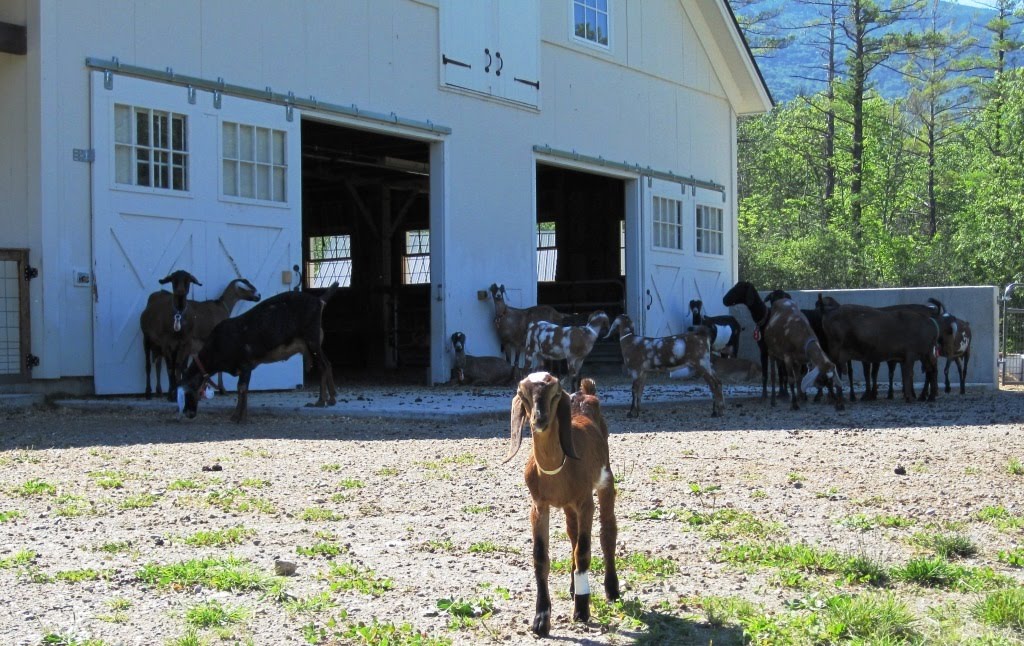 Quite well-behaved and friendly goats, too. Here a couple of kids try unsuccessfully to get some food from Emily:
 The goats are milked in this milking parlor, six at a time: This news release describes cheesemaking at the Center. We bought some chevre and Havarti cheese in the gift shop, both quite good. This news release describes the Center's commitment to renewable energy.
Hildene
One of the lesser-known treasures in Vermont is Hildene, the historic summer home of Robert Todd Lincoln in Manchester:
 Robert Todd Lincoln was the only child of President Abraham Lincoln to survive to adulthood. He was a successful lawyer and businessman associated with the Pullman Company in Chicago. He also served as Secretary of War under Presidents Garfield and Arthur (1881-1885) and ambassador to Britain under President Harrison (1889-1893).
The Pullman Company, founded by George Pullman, was famous for manufacturing sleeper railroad cars. Mr. Pullman hired Robert Todd Lincoln as general counsel, and Mr. Lincoln became president after Mr. Pullman's death. Much company business was conducted at Hildene. Financial reports from the company are on display there.
Robert Todd Lincoln died at Hildene in 1926. His descendants lived there until the last one died in 1975. The site is now beautifully maintained by the Friends of Hildene. In the back of the house is a formal garden laid out in the style of a stained-glass cathedral window:
 There are no overnight accommodations at Hildene, but they do host corporate dinners and weddings. Nancy, Emily and I visited on July 3rd. What a beautiful day for a wedding! The photo above shows the setup for a wedding reception in the formal garden. (The setup for the actual wedding ceremony, not shown, was at the other end of the formal garden.) Elsewhere on the property, they were setting up for a rehearsal dinner for a different wedding to be held the following day.
The docents at Hildene helpfully explained much about the property including the contents of the house. We listened to music on the 1000-pipe Aeolian player organ. A young man talked to us about the many books there, which he had catalogued, including the complete works of William Shakespeare and folios of all of the works in the Louvre. One of the things discovered in the house when it was restored was Robert Todd Lincoln's notes from when he had his mother, Mary Todd Lincoln, committed to a psychiatric asylum. One room in the house was set up museum-style to showcase President Lincoln's Second Inaugural Address.
Robert Todd Lincoln was an avid amateur astronomer, and the estate included an observatory with a 6-inch refracting telescope which we were told is still occasionally used. Mr. Lincoln also maintained a farm at Hildene. Major changes have recently been made to the farm, but that deserves its own post.
 Robert Todd Lincoln was the only child of President Abraham Lincoln to survive to adulthood. He was a successful lawyer and businessman associated with the Pullman Company in Chicago. He also served as Secretary of War under Presidents Garfield and Arthur (1881-1885) and ambassador to Britain under President Harrison (1889-1893).
The Pullman Company, founded by George Pullman, was famous for manufacturing sleeper railroad cars. Mr. Pullman hired Robert Todd Lincoln as general counsel, and Mr. Lincoln became president after Mr. Pullman's death. Much company business was conducted at Hildene. Financial reports from the company are on display there.
Robert Todd Lincoln died at Hildene in 1926. His descendants lived there until the last one died in 1975. The site is now beautifully maintained by the Friends of Hildene. In the back of the house is a formal garden laid out in the style of a stained-glass cathedral window:
 There are no overnight accommodations at Hildene, but they do host corporate dinners and weddings. Nancy, Emily and I visited on July 3rd. What a beautiful day for a wedding! The photo above shows the setup for a wedding reception in the formal garden. (The setup for the actual wedding ceremony, not shown, was at the other end of the formal garden.) Elsewhere on the property, they were setting up for a rehearsal dinner for a different wedding to be held the following day.
The docents at Hildene helpfully explained much about the property including the contents of the house. We listened to music on the 1000-pipe Aeolian player organ. A young man talked to us about the many books there, which he had catalogued, including the complete works of William Shakespeare and folios of all of the works in the Louvre. One of the things discovered in the house when it was restored was Robert Todd Lincoln's notes from when he had his mother, Mary Todd Lincoln, committed to a psychiatric asylum. One room in the house was set up museum-style to showcase President Lincoln's Second Inaugural Address.
Robert Todd Lincoln was an avid amateur astronomer, and the estate included an observatory with a 6-inch refracting telescope which we were told is still occasionally used. Mr. Lincoln also maintained a farm at Hildene. Major changes have recently been made to the farm, but that deserves its own post.
Sunday, June 27, 2010
Shooting
Brian came home for the weekend to help celebrate my birthday, and we went shooting today at the Sportsman's Club of Franklin County:
 Yup, that's Emily in the background. After many years on archery ranges, I think this was her first time on a rifle range.
Nancy went, too. Here's a video of a milk jug that she shot:
That one was at 50 yards with the Encore .222 rifle. She also hit a milk jug at 100 yards with the Encore .222 pistol—on her first shot with the pistol.
Nancy shot the best group of the day (5 shots at 100 yards with the Encore .222 rifle—1.25"):
 Don't mess with Nancy!
Pictures and video taken with my new camera, a birthday present. It's pretty cool!
 Yup, that's Emily in the background. After many years on archery ranges, I think this was her first time on a rifle range.
Nancy went, too. Here's a video of a milk jug that she shot:
That one was at 50 yards with the Encore .222 rifle. She also hit a milk jug at 100 yards with the Encore .222 pistol—on her first shot with the pistol.
Nancy shot the best group of the day (5 shots at 100 yards with the Encore .222 rifle—1.25"):
 Don't mess with Nancy!
Pictures and video taken with my new camera, a birthday present. It's pretty cool!
Saturday, June 26, 2010
Too Much Debt
The G-20 Toronto Summit starts today. President Obama will argue for increased government spending (financed by debt) to stimulate the global economy, a distinctly Keynesian idea. The European countries will argue for restraint. It looks to be interesting.
The Economist recently published a special report on debt* and a related column on world debt. The column has a cool interactive graphic that shows debt for the major developed countries broken down by sector: government, household, nonfinancial business and financial business. Highly recommended reading.
*The special report has multiple parts. This link takes you to the first part. At that link, see the sidebar "In this special report" for links to the other parts.
Here's a quote that captures the main theme: "Borrowing has been the answer to all economic troubles in the past 25 years. Now debt itself has become the problem."
Like Keynes, The Economist is from England, but that seems to be about all they have in common. On our side of the pond, the Wall Street Journal also has an editorial today on this topic: The Keynesian Dead End.
Previous posts on this general topic: Fear the Boom and Bust (about Keynes and Hayek) and Greece's Financial Problems.
The Economist recently published a special report on debt* and a related column on world debt. The column has a cool interactive graphic that shows debt for the major developed countries broken down by sector: government, household, nonfinancial business and financial business. Highly recommended reading.
*The special report has multiple parts. This link takes you to the first part. At that link, see the sidebar "In this special report" for links to the other parts.
Here's a quote that captures the main theme: "Borrowing has been the answer to all economic troubles in the past 25 years. Now debt itself has become the problem."
Like Keynes, The Economist is from England, but that seems to be about all they have in common. On our side of the pond, the Wall Street Journal also has an editorial today on this topic: The Keynesian Dead End.
Previous posts on this general topic: Fear the Boom and Bust (about Keynes and Hayek) and Greece's Financial Problems.
Sunday, June 13, 2010
The Language God Talks
 Herman Wouk wrote the best historical novels ever about World War II: The Winds of War and War and Remembrance. They are exciting and gripping stories, yet factual and complete. Highly recommended. These two books were also made into two minseries, available on DVD.
It turns out that while writing those books Herman Wouk had several conversations with one of my heroes: Richard Feynman. I didn't know that before, but learned it from a new nonfiction book that Herman Wouk just published: The Language God Talks: On Science and Religion. The title of the book comes from Wouk's first meeting with Feynman: "...[Feynman] said as we were parting, 'Do you know calculus?' I admitted that I didn't. 'You had better learn it,' he said. 'It's the language God talks.' "
Wouk and Feynman were contemporaries, both born in New York City—Wouk in 1915 and Feynman in 1918. Both of their families were Jewish, and from the same city in Russia. Yet they did not meet until mid-life. The Language God Talks is dedicated: "To the memory of our fathers, Abraham Isaac Wouk and Melville Feynman, who emigrated from Minsk and gave us our lives in America."
Feynman turned his back on religion at about age ten. Wouk embraced religion in his 20s. The book is a "debate" that Wouk has with his good friend Feynman about science and religion. Feynman must have made quite an impression on Herman Wouk, because Feynman has been dead for 22 years, and Wouk is still debating with him.
Feyman once said in an interview: "The stage is too big for the drama." Meaning: the universe is too big a stage for human drama to be anything special. Wouk wrote The Language God Talks to dispute this statement.
Wouk never did learn calculus (although he tried), and he quotes a Jewish microbiologist who is also a Torah scholar as describing calculus as "His [God's] other language" (my emphasis). Wouk ends the debate with the word teiku (the question stands), and these words: "...forgive me, friend Nobel genius, you're as ignorant of religion as I am of calculus."
Even though Herman Wouk may be ignorant of calculus, The Language God Talks contains a good overview of science. For religion and the "struggle for good and evil" (Feynman's words for the human drama), Mr. Wouk draws on his World War II novels with their underlying theme of the Holocaust. How could a good and gracious God allow the Germans, an advanced people, to do such evil?
Herman Wouk's answer was in War and Remembrance, in a sermon by his character Aaron Jastrow in the Theresienstadt ghetto. The title of the sermon is "Heroes of the Iliad," but Jastrow (and Wouk) find the answer not in the Iliad but in the Book of Job. The sermon is reprinted and explained in The Language God Talks.
One additional interesting connection that I learned from The Language God Talks is that another person whom Herman Wouk talked to when he was writing his World War II novels was Dr. Raul Hilberg, a professor of political science at UVM from 1955 to 1991. I had not heard of Dr. Hilberg, but according to Wikipedia, he was "widely considered to be the world's preeminent Holocaust scholar." Mr. Wouk visited Dr. Hilberg at UVM and spoke at his retirement party in 1991. Dr. Hilberg lived in Williston until his death in 2007.
You can read the first few pages of The Language God Talks here:
Is God a mathematician?
Friday, June 4, 2010
Snow Crash
 Snow Crash by Neal Stephenson is a science fiction novel about viruses. It's both deep and funny, the ironic humor starting with a main character named Hiro Protagonist.
A discussion of the title: Hiro: " 'This Snow Crash thing—is it a virus, a drug, or a religion?' Juanita shrugs. 'What's the difference?' " (p. 200)
Themes include computer viruses, biological viruses and viral ideas, all interconnected from ancient Sumerian mythology to a futuristic virtual reality called the Metaverse. Language is a key theme, beginning with the Biblical story of Babel (Genesis 11:1-9) and continuing to the modern concepts of DNA (the language of biology) and the binary language of digital computers.
The book is also full of thrilling action and unforgettable characters, such as Y.T. (Yours Truly), a 15-year old girl with a high-tech skateboard and Attitude.
Neal Stephenson is both an entertaining author and a deep thinker. Over on my work blog, I have mentioned another book by Neal Stephenson that is about a near future world where nanotechnology is ubiquitous: The Diamond Age. His magnum opus is Cryptonomicon, which I have also read, but not yet blogged about. All highly recommended.
Snow Crash was published in 1992, before the Internet and World Wide Web became widely popular. (The first popular web browser, Mosaic, was released in 1993.) Note that Neal Stephenson is apparently a friend of Jaron Lanier, whom I wrote about last month: You Are Not a Gadget (see the Update).
Friday, May 28, 2010
Emily's Graduation
Emily graduated from Middlebury College on Sunday, May 23, 2010. It was a beautiful day! The flags on the building are from the countries with students in the graduating class:
 Emily graduated with a bachelor of arts degree in biology and a minor in religion. Congratulations, Emily! Well done!
 Emily and some of her friends:


 Each graduate was given a replica of Gamaliel Painter's cane. Mr. Painter helped found Middlebury College and he left his estate and his cane to the college when he died in 1819. Painter Hall is named after him.
The commencement speakers were Nicholas Kristof and Sheryl WuDunn. The student speaker was Peter Baumann. Click here for the news release about the graduation. Click here for the Commencement Address Archive.
That evening some of Emily's friends and their families came to our house for a cookout:

 Emily graduated with a bachelor of arts degree in biology and a minor in religion. Congratulations, Emily! Well done!
 Emily and some of her friends:


 Each graduate was given a replica of Gamaliel Painter's cane. Mr. Painter helped found Middlebury College and he left his estate and his cane to the college when he died in 1819. Painter Hall is named after him.
The commencement speakers were Nicholas Kristof and Sheryl WuDunn. The student speaker was Peter Baumann. Click here for the news release about the graduation. Click here for the Commencement Address Archive.
That evening some of Emily's friends and their families came to our house for a cookout:

Thursday, May 27, 2010
Emily's Baccalaureate
The day before Emily's graduation was baccalaureate and a few other activities. Click here for President Liebowitz's baccalaureate address (interesting info about the graduating class and the history of Middlebury College).
Here is the family in front of Mead Memorial Chapel after baccalaureate:
 Emily's senior thesis was based on work done in Dr. Grace Spatafora's lab. Emily showed us where she spent a lot of time this past year:
 That evening Dr. Spatafora had a reception at her home for the students in her lab this year. Below is Emily with three of her four lab mates and Dr. Spatafora:

Here is the family in front of Mead Memorial Chapel after baccalaureate:
 Emily's senior thesis was based on work done in Dr. Grace Spatafora's lab. Emily showed us where she spent a lot of time this past year:
 That evening Dr. Spatafora had a reception at her home for the students in her lab this year. Below is Emily with three of her four lab mates and Dr. Spatafora:
Sunday, May 16, 2010
You Are Not a Gadget
 The book You Are Not a Gadget by Jaron Lanier is a fascinating counterpoint to some earlier posts on this blog.
Jaron Lanier is a technologist, one of the pioneers of virtual reality, who has come to question where our current technology is taking us. He asks the following basic, related, philosophical questions:
1. Are humans special?
2. What is the proper relationship between the individual and the group?
Jaron Lanier argues that humans are special, and that our current technology is problematic because it emphasizes the group to the exclusion of the individual.
This is the opposite of Stephen Wolfram: "...there is nothing fundamentally special about us [humans]." (A New Kind of Science, p. 844) It is the opposite of Ray Kurzweil's The Singularity is Near (movie due out Sept. 1, 2010). I think Jaron Lanier's position is the opposite of most technologists. For a few examples, see any of my earlier blog posts with the label "reality" (and follow the links). I briefly mentioned Jaron Lanier in my first post on the reality question.
Jaron Lanier argues that our current path of technological design (e.g., Web 2.0) is leading us into a "new religion" (p. 32) that he calls cybernetic totalism where humans are slaves of technology instead of the other way around. He believes "that cybernetic totalism will ultimately be bad for spirituality, morality, and business." (p. 119) And especially bad for human creativity.
In contrast to cybernetic totalism, Mr. Lanier posits humanism and "an idea of progress that is centered on enriching the depth of communication instead of the acquisition of powers." (p. 179)
This book is not just about computers. Here are a few of the other interesting topics woven into this book:
- music
- advertising
- economics and money
- evolutionary biology
- language
- how the sense of smell is different from vision and hearing
- cephalopods
For more information about You Are Not a Gadget, see:
Jaron Lanier's web site about the book
Staying Human in a Tech-Driven World, a talk by Jaron Lanier at Zócalo Public Square at about the time the book was published in January 2010 (the talk is 54 minutes, followed by 18 minutes of questions and answers)
You Are Not a Gadget was published in 2010. Reviews:
Wall Street Journal 1/12/10 (Instapundit)
New York Times 1/14/10
Washington Post 1/14/10
UPDATE 6/04/10: In the Acknowledgements, Jaron Lanier writes "Superspecial thanks to early readers of the manuscript," one of whom was Neal Stephenson. I write about Neal Stephenson in this post: Snow Crash.
Subscribe to:
Posts (Atom)