Sunday, October 3, 2010

Sugarloaf

We climbed Sugarloaf Mountain yesterday with Susan and Paul. It was a beautiful day, although cool and breezy on top. Nancy on the summit with Crocker Mountain in the background:

Our plan had been to go up the Appalachian Trail from Caribou Valley, but it had recently rained hard and the stream near the start of the trail (the South Branch of the Carrabassett) was too high to cross. So we drove back around to the ski area and hiked up and down ski trails.

Foliage was about peak. The view from the Haulback ski trail on the way down, with Bigelow Mountain in the background:

Sunday, August 29, 2010

Rural Uplook Service

Liberty Hyde Bailey was an influential horticulturist in the late 1800s and early 1900s. He founded Cornell University's College of Agriculture and was its first dean. In 1908 President Teddy Roosevelt selected Prof. Bailey to chair a National Commission on Country Life. The report published by this commission influenced the founding of the Cooperative Extension Service in 1914, the evolution of 4-H, and the creation of the Farm Credit System in 1916.

More info on Liberty Hyde Bailey: National 4-H Hall of Fame entry, Cornell University bio, Wikipedia entry.

Much of Prof. Bailey's work built on the foundation of the land grant university system—see my earlier post about Justin Smith Morrill. Cornell University is New York's land grant university. It has both a Morrill Hall and a Bailey Hall. Cornell further honors Prof. Bailey with the Liberty Hyde Bailey Leadership Society. Several northeast Farm Credit employees are members of this society, and many employees are Cornell graduates. Other employees, like me, graduated from New England land grant universities, but the influence of Cornell University on Farm Credit is strong and it began with Liberty Hyde Bailey.

I recently encountered Liberty Hyde Bailey in another context, outside of Farm Credit. A few days ago Nancy found a box in our attic that I had forgotten about. It was a box of papers that my mother had given to me about her father. One of the things in the box was a book by Prof. L. H. Bailey titled RUS. The title stands for Rural Uplook Service ("rus" is also Latin for "the country"). The goal of RUS was to "compile compact information about those persons who are now contributing through their achievements to the betterment and advancement of country life." It was basically a "who's who" of rural United States and Canada.

There were two editions of RUS. The 1918 edition listed 2,746 names and the 1920 edition listed 4,631 names. I had not heard of RUS before, but both editions are now in the public domain and available online in full, searchable versions at Google Books (links below). The book in the box in our attic was the 1920 edition.

The reason the book was in the box was because my grandfather was in it. But I also discovered that my great-grandfather on my father's side was in it, too. At the time, my mother's father was a minister in Cambridge, where my father's grandfather was a farmer and church member. If you are curious, see the entry for Walter Hollis Gould on page 181 and the entry for Luther Putnam on page 368 in the 1920 edition. Neither is in the 1918 edition.

(For notes about Luther Putnam's farm see my earlier post on Westview Farm.)

Another item in the box was a church newsletter written by Rev. Walter H. Gould and featuring a photo of Luther Putnam—"one of our oldest members." Here is the first page of the 12-page newsletter:

(Click on the image to enlarge.) The newsletter is also dated 1920.

The young minister (age 35) and the old farmer (age 78) clearly knew each other in 1920, the year they both appeared in RUS. The farmer lived his entire life in the adjoining towns of Cambridge and Westford. The minister had only been in Cambridge for three years and would leave within a year for other towns in Vermont. But it was enough time to establish a connection between the two families. The minister's oldest daughter, then four years old, would return in later years, after graduating from UVM, and marry one of the old farmer's grandsons. The old farmer would not live to see that, but the minister would return to Cambridge, where the newlyweds would live on the family farm, to perform the wedding ceremony.

Saturday, August 28, 2010

The First Patent

U.S. patent #1, issued in 1790 and signed by George Washington, was granted to Samuel Hopkins for an improved method of making potash. Potash, consisting mainly of potassium carbonate, was then made from hardwood logs and was widely used in manufacturing many products including soap, glass, dyes and gunpowder. Potash was "America's first industrial chemical" and it was probably the first major agricultural product in America that was sold for money.

Until recently it was thought that Patent #1 was granted to a Samuel Hopkins from Pittsford, Vermont. In 1998 it was discovered that the real Samuel Hopkins of Patent #1 fame was from Philadelphia.

Many people still think that the Samuel Hopkins who lived in Pittsford, Vermont earned the first patent. Below is a historical marker to this effect on US-7 in Pittsford (photo taken 7/3/10):

The sign mentions pearl-ash, which was a form of potash.

How did such a case of mistaken identity occur? In 1836 a fire destroyed the U.S. Patent and Trademark office. All records pertaining to the first 10,280 patents were lost. I don't know the full history of how this case of mistaken identity occurred, but the correct Samuel Hopkins was apparently discovered by someone named David Maxey. He published articles in the Jan/Apr 1998 issue of the Pennsylvania Magazine of History & Biography and the March 1998 issue of the Journal of the Patent & Trademark Office Society.

In 2002 the State of Pennsylvania erected their own historical marker to Samuel Hopkins in Philadelphia (source and more info):

At the time of the first patent the seat of the U.S. government was in Philadelphia, and Vermont was still an independent republic—not even part of the United States yet. (The new U.S. government began operations in 1789, initially in New York. In the summer of 1790 it moved to Philadelphia for ten years while new government buildings were constructed in Washington, DC. Vermont was an independent republic for 14 years beginning in 1777, becoming the 14th state in 1791.) Taking those historical facts into account, it seems altogether reasonable that the recipient of the first U.S. patent was from Philadelphia not Vermont.

I cannot find Mr. Maxey's articles online, but an excellent online article is The First Patent, by Henry M. Paynter. Dr. Paynter was an emeritus professor of mechanical engineering at MIT who retired to Pittsford, Vermont in 1985 and died at his home there in 2002. (obituary) In his retirement, Dr. Paynter became interested in the history of the first patent. This article also describes the importance of the potash industry to colonial America and the young United States. The quote above about potash being "America's first industrial chemical" came from this article.

There are photos of the potash kettles in Pager's lilac garden and in Beth's garden in this 5/11/08 post on my work blog: The Forgotten Potash Economy.

Awesome College Labs

Awesome photos and info!

30 Awesome College Labs

Check out Cornell University-computer games (#8), MIT-toys (#12) and Boston University-infectious diseases (#30).

I think Dr. Grace Spatafora's lab is pretty cool, too (2nd photo here).

Saturday, July 31, 2010

Justin Smith Morrill Homestead

Justin Smith Morrill represented Vermont in the U.S. Congress for 44 years in the last half of the 1800s, first as a representative and then as a senator. He is most well known for the Morrill Land-Grant Colleges Act of 1862 that established the land grant university system.

Senator Morrill was born 200 years ago in Strafford, VT. In 1848-1851 he constructed the Morrill Homestead in Strafford, which since 1960 has been a National Historic Landmark. Nancy and I visited it on July 25:

We did not do the house tour (perhaps we should have) but we did do the self-guided tour of the grounds. There was a well-done interpretive display about Senator Morrill's life and accomplishments in the carriage barn. It was an interesting historical site, and I recommend it. The site is open only part of the time, so be sure to check the official web site for hours of operation.

Senator Morrill is in the Vermont Agricultural Hall of Fame. Many land grant universities today have a Morrill Hall in honor of Senator Morrill, such as this one at UVM.

Here's something I learned while researching this post: MIT is a land grant university!

Putnam Family Reunion

Nancy and I attended a reunion of a branch of the Putnam family on July 25. This branch of the family includes four Putnam sisters who grew up in Bethel, VT: Fran, Margaret, and the twins Loraine and Louise. The reunion was held at the farm of Fran and Art Hyde in Bradford, VT. Below are Fran, Nancy, Art, me and Loraine:

We have two other connections to Fran and Art. Fran Putnam was maid of honor at the wedding of Nancy's parents in 1953. And Art Hyde was a Farm Credit director for some 26 years, including a few years as chairman of the board of the Farm Credit Banks of Springfield in the 1970s. That was before my time at Farm Credit, as I started in 1984, but we had good discussions about Farm Credit.

Sunday, July 18, 2010

Beaver Meadow Lodge

Nancy and I hiked to Beaver Meadow Lodge today:

Beaver Meadow Lodge is located on the Beaver Meadow Trail, just off the Long Trail, in Morristown. The Chilcoot Trail leads in 0.8 miles to the LT at Chilcoot Pass on Madonna Mountain, and the Whiteface Trail leads in 1.0 miles to the LT at Whiteface Shelter on the side of Whiteface Mountain. Click here for a cool hand-drawn map.

The sign on the lodge says: "Welcome. Property of Sterling Section G.M.C." The lodge was built in 1946-47 by the Sterling Section of the Green Mountain Club. Click here for an interesting history of the Sterling Section written by Smith Edwards.

The outhouse has a nice view of the woods:

Sunday, July 11, 2010

Caring for Your Introvert

An interesting column from the March 2003 issue of The Atlantic: "Caring for Your Introvert" by Jonathan Rauch.

That column was one of the most popular pieces ever posted on The Atlantic, as noted in this follow-up interview with Mr. Rauch in February 2006: "Introverts of the World, Unite!"

What's the difference between an extrovert and an introvert? Extroverts are energized by talking with other people. That tires out introverts. Extroverts are bored by solitary thinking, while introverts thrive on it. No one is completely at either extreme, of course, but people often have definite tendencies in one direction or the other.

The second page of the interview gets into some interesting subjects, like geeks. It also mentions how introverts typically don't enjoy making small talk about the weather. I agree with that, and would add another topic: sports. Small talk about sports permeates our society, but it is often of little interest to an introvert.

So if you are an introvert, keep your chin up. There's nothing wrong with you, and you are not alone!

The Farm at Hildene

The farm at Hildene opened the new Rowland Agricultural Center in 2009:

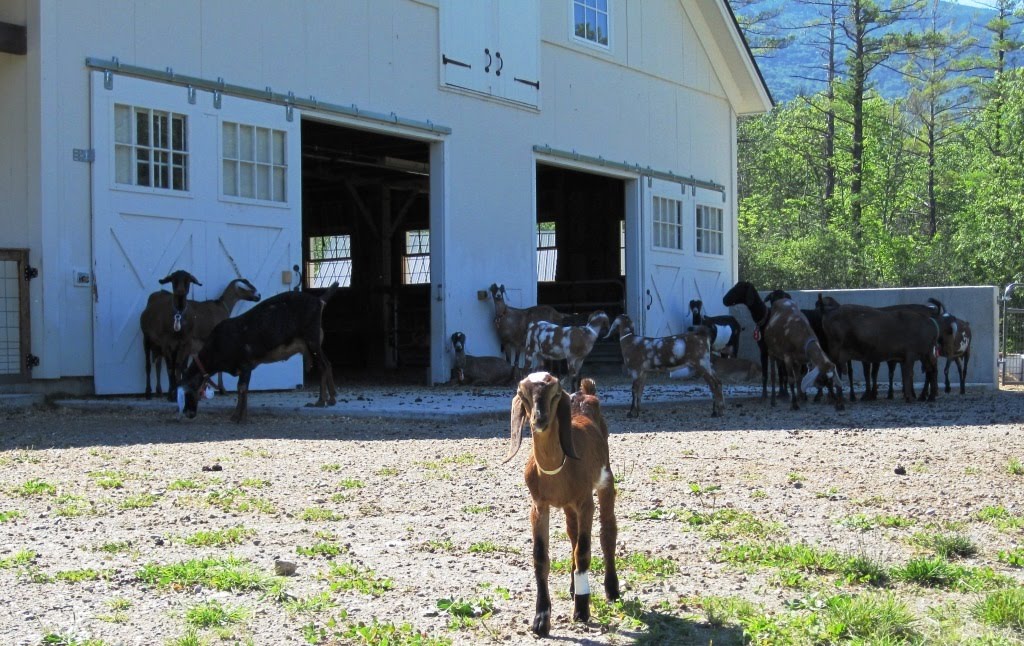
The Center features cheesemaking facilities, a classroom, solar energy (panels on the other side of the roof) and a wood burning furnace (that's the smokestack through the roof). And not for cows, but for Nubian goats:

Quite well-behaved and friendly goats, too. Here a couple of kids try unsuccessfully to get some food from Emily:

The goats are milked in this milking parlor, six at a time:

This news release describes cheesemaking at the Center. We bought some chevre and Havarti cheese in the gift shop, both quite good. This news release describes the Center's commitment to renewable energy.

Hildene

One of the lesser-known treasures in Vermont is Hildene, the historic summer home of Robert Todd Lincoln in Manchester:

Robert Todd Lincoln was the only child of President Abraham Lincoln to survive to adulthood. He was a successful lawyer and businessman associated with the Pullman Company in Chicago. He also served as Secretary of War under Presidents Garfield and Arthur (1881-1885) and ambassador to Britain under President Harrison (1889-1893).

The Pullman Company, founded by George Pullman, was famous for manufacturing sleeper railroad cars. Mr. Pullman hired Robert Todd Lincoln as general counsel, and Mr. Lincoln became president after Mr. Pullman's death. Much company business was conducted at Hildene. Financial reports from the company are on display there.

Robert Todd Lincoln died at Hildene in 1926. His descendants lived there until the last one died in 1975. The site is now beautifully maintained by the Friends of Hildene. In the back of the house is a formal garden laid out in the style of a stained-glass cathedral window:

There are no overnight accommodations at Hildene, but they do host corporate dinners and weddings. Nancy, Emily and I visited on July 3rd. What a beautiful day for a wedding! The photo above shows the setup for a wedding reception in the formal garden. (The setup for the actual wedding ceremony, not shown, was at the other end of the formal garden.) Elsewhere on the property, they were setting up for a rehearsal dinner for a different wedding to be held the following day.

The docents at Hildene helpfully explained much about the property including the contents of the house. We listened to music on the 1000-pipe Aeolian player organ. A young man talked to us about the many books there, which he had catalogued, including the complete works of William Shakespeare and folios of all of the works in the Louvre. One of the things discovered in the house when it was restored was Robert Todd Lincoln's notes from when he had his mother, Mary Todd Lincoln, committed to a psychiatric asylum. One room in the house was set up museum-style to showcase President Lincoln's Second Inaugural Address.

Robert Todd Lincoln was an avid amateur astronomer, and the estate included an observatory with a 6-inch refracting telescope which we were told is still occasionally used. Mr. Lincoln also maintained a farm at Hildene. Major changes have recently been made to the farm, but that deserves its own post.

Sunday, June 27, 2010

Shooting

Brian came home for the weekend to help celebrate my birthday, and we went shooting today at the Sportsman's Club of Franklin County:

Yup, that's Emily in the background. After many years on archery ranges, I think this was her first time on a rifle range.

Nancy went, too. Here's a video of a milk jug that she shot:


That one was at 50 yards with the Encore .222 rifle. She also hit a milk jug at 100 yards with the Encore .222 pistol—on her first shot with the pistol.

Nancy shot the best group of the day (5 shots at 100 yards with the Encore .222 rifle—1.25"):

Don't mess with Nancy!

Pictures and video taken with my new camera, a birthday present. It's pretty cool!

Saturday, June 26, 2010

Too Much Debt

The G-20 Toronto Summit starts today. President Obama will argue for increased government spending (financed by debt) to stimulate the global economy, a distinctly Keynesian idea. The European countries will argue for restraint. It looks to be interesting.

The Economist recently published a special report on debt* and a related column on world debt. The column has a cool interactive graphic that shows debt for the major developed countries broken down by sector: government, household, nonfinancial business and financial business. Highly recommended reading.

*The special report has multiple parts. This link takes you to the first part. At that link, see the sidebar "In this special report" for links to the other parts.

Here's a quote that captures the main theme: "Borrowing has been the answer to all economic troubles in the past 25 years. Now debt itself has become the problem."

Like Keynes, The Economist is from England, but that seems to be about all they have in common. On our side of the pond, the Wall Street Journal also has an editorial today on this topic: The Keynesian Dead End.

Previous posts on this general topic: Fear the Boom and Bust (about Keynes and Hayek) and Greece's Financial Problems.