Sunday, May 21, 2017

Saint John, New Brunswick


Today we drove from Bangor, Maine (A) to Saint John, New Brunswick (B), a drive of just over three hours. The city of Saint John is on the southern edge of the province, where the 400 mile long Saint John River flows into the Bay of Fundy. (Click on any image to enlarge.)

The Bay of Fundy is famous for its high tides, and Saint John is known for the Reversing Falls on the Saint John River caused by those tides:


We did not see the Reversing Falls in action. The Saint John River was too swollen with water from snowmelt and spring rains for the usual effect.

The Reversing Falls occur in a short, narrow gorge and immediately upstream from the gorge. It is a significant tourist attraction, as can be inferred from the sign above. However, we were there before the tourist season had begun and no tourist attractions were open except the outdoor parks on either side of the river—Wolastoq Park and Fallsview Park. A restaurant on the gorge was under renovation; the photo above shows a construction trailer behind the sign.

Below is a view of the gorge from Wolastoq Park on the south side of the river. Spanning the gorge are a highway bridge on the right and a railway bridge to its left. The tourist sign, construction trailer and restaurant are visible at the near end of the highway bridge. The river flows from left to right in this photo:


When open, the restaurant at the Reversing Falls will include a skywalk. The photo below is looking up at the skywalk and restaurant from the south bank of the river:


Wolastoq Park is on a small hill on the south side of the river. Wolastoq (“the beautiful river”) was the name of the river in the language of the Native Americans. The park has great views and contains a dozen or more large wooden statues of figures that are significant in the history of Saint John.

One of the statues in Wolastoq Park is Samuel de Champlain, who in 1604 on his second voyage to the New World as a mapmaker for King Henry IV of France, sailed into the river (as far as the Reversing Falls) on June 24. That is the feast day of Saint John the Baptist, hence the current name of the river and the city. Below is the statue of Champlain:


Another statue in the park is Benedict Arnold, who lived in Saint John for a few years after he wore out his welcome in the American Colonies. He became disliked in Saint John as well, and left for England in 1791. Saint John was a popular city for refugee loyalists from the new United States following the American Revolution.

Wolastoq Park was created in 2004 and is maintained by J.D. Irving Limited, named for James Durgavel (J.D.) Irving, who started business with a sawmill in Bouctouche, NB in 1882. His son Kenneth Colin (K.C.) Irving (1899-1992) built the Irving companies into a formidable business empire. In 1998 Maclean's Magazine named K.C. Irving the most influential Canadian businessman of the 20th century. Below is the statue of K.C. Irving in Wolastoq Park:


Fallsview Park is on the other side of the river, a short ways upstream from the railway bridge. It is one of the best places to view the Reversing Falls. Directly across the river from Fallsview Park is Union Point which has been a site for various mills since the 1830s. The current mill is a pulp mill belonging to the Irving companies. Below is the mill from Wolastoq Park:


In colonial times, Britain and France fought bitterly over eastern Canada. Britain won control over all of Canada in 1763 at the conclusion of the Seven Years War (what we in the U.S. call the French and Indian War), but there remains a significant French influence in many parts of Canada. Both the English and French languages are used by the Canadian federal government, but most provinces privilege one language over the other. The province of Quebec privileges French. Most provinces privilege English. New Brunswick is the only one of the ten Canadian provinces to treat the French and English languages exactly equal. This was evident in all the signs we saw.

Saturday, May 20, 2017

Loggers Expo


The annual Northeastern Forest Products Equipment Exposition, usually called the Loggers Expo, was held in Bangor, Maine, on May 19-20. Paul and I attended today.

There was plenty of big equipment! Shown above is a John Deere 1270G wheeled harvester. Below are John Deere 853M and 853MH tracked feller bunchers/harvesters:


There were also plenty of displays of small equipment, even hand tools. Firewood is being made here:


In the photo above, note the grandstand in the background. It says “Bass Park Home of Bangor State Fair.” The other major building in the fair complex is the Cross Insurance Center, built in 2013. Below is a photo of exhibits inside the arena in the Cross Center:


In front of the Cross Center is a statue of Paul Bunyan, a fictional giant lumberjack who is significant in the folklore of the American timber industry:


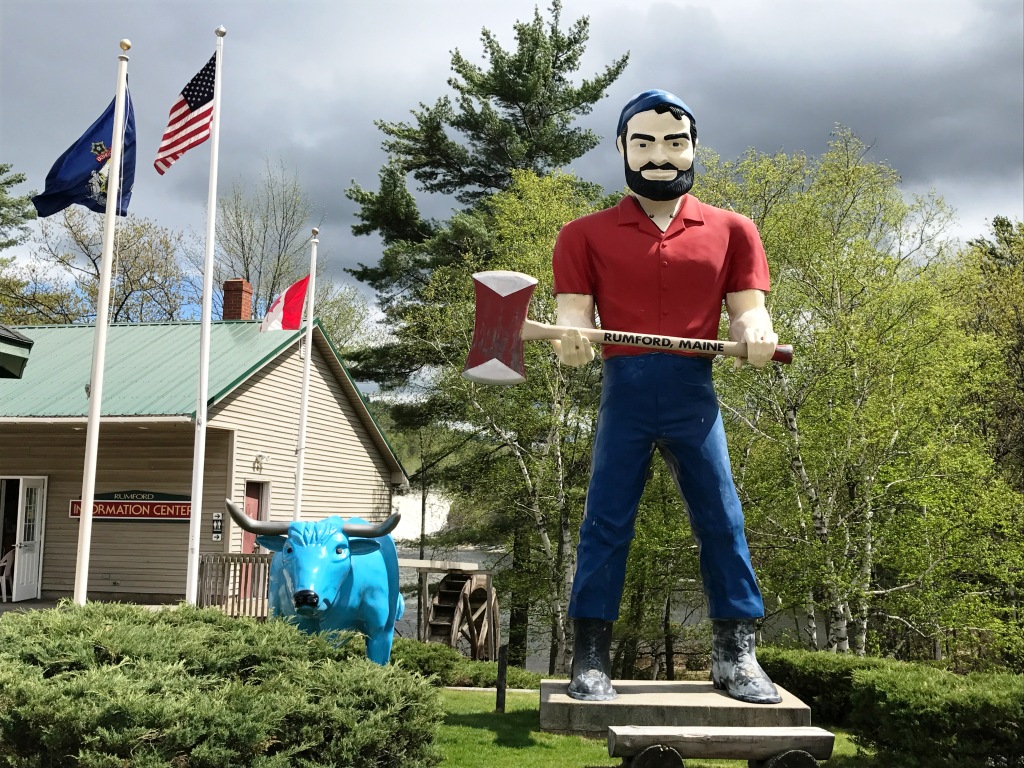
But this is not the only statue of Paul Bunyan in Maine! Rumford also has a statue of Paul, accompanied by Babe the Blue Ox:


I won't mention the fact that Michigan, Wisconsin and Minnesota also claim Paul and Babe as their own.

The Loggers Expo alternates between Bangor in odd years and the Champlain Valley Exposition in Essex Junction, Vermont, in even years. If you have a chance to go, it is worth the price of admission.

Monday, May 15, 2017

Maggie's Farm Urban Hike


Nancy and I participated in the Third Annual Maggie's Farm Urban Hike on Sunday, May 7. It was a wonderful adventure! The hike was in midtown Manhattan from the Lincoln Center to Greenwich Village. Bird Dog of the Maggie's Farm blog has photos and details here:

A few pics from the 3rd Annual Maggie's Urban Hike, with great pizza, beer, and cupcakes

I have little to add to Bird Dog's account. Nancy and I were visiting Emily in New Haven that weekend. We took the train from New Haven to Grand Central Terminal and walked from there to the Lincoln Center for the start of the hike. At the end of the hike we were part of a subgroup that walked from Greenwich Village back to Grand Central Terminal, and Nancy and I took the train back to New Haven. My Fitbit registered 28,662 steps for the day.

That day was also the day of the Five Boro Bike Tour in New York. Below is a photo of bicyclists that Nancy and I saw on the Avenue of the Americas (Sixth Avenue) on our walk from Grand Central Terminal to the Lincoln Center before the start of the hike:


I have only one photo from the hike of something not included in Bird Dog's excellent account – the smallest piece of private property in New York City, the Hess Triangle:


It was good weather for hiking, cool and overcast with no serious rain until the end of the day as we returned to Grand Central Terminal. The clock on the terminal in the photo below says 4:37 PM.


The photo at the top of this post is the World Trade Center from 6th Avenue and W 10th Street. That view brings to mind many thoughts, from September 11, 2001 to when I discovered blogs as a direct result of my first ever visit to New York City in April 2002. That story is here.

Monday, May 8, 2017

Shelburne Falls


Shelburne Falls in northwestern Massachusetts is a beautiful village just off I-91. I have driven by the exit many times over the years, but never stopped until today when Nancy and I took the scenic route home after visiting Emily in New Haven for the weekend.

Flowers were in bloom on the famous Bridge of Flowers, a former trolley bridge over the Deerfield River:


The Bridge of Flowers is just upstream from the falls in the photo at the top of this post. This area was "once a prime salmon fishing spot for native Americans" (source) and the falls are sometimes called Salmon Falls as explained in the sign below (click on any photo to enlarge):


The Deerfield River in Shelburne Falls is famous for ancient glacier pot holes, as explained in the sign below, but the river was too high for us to see them:


There was a lot to see and do in the village, including several artists shops. We had brunch at the Foxtown Diner – highly recommended (cash only). Below are two interesting signs in a shop window:


The sign on the left is titled "Bridges Bring People Together." The sign on the right says:

Meet the Candidates
for Shelburne Selectboard 2017
Monday, May 8, 7:00 PM

Alas, we could not stay, but I can identify with that!

Saturday, May 6, 2017

Silver Sands State Park


Silver Sands State Park is on Long Island Sound in Milford, Connecticut. It has a long boardwalk which Nancy, Emily and I strolled on today. Below is the portion of the boardwalk over the tidal channel of Fletcher's Creek:


Charles Island is visible in the photo above in the distance to the right. At low tide one can walk across the sandbar (tombolo) to the island. Local legend holds that Captain Kidd's buried treasure is on the island. We walked out toward the island as far as we could (photo below).


We saw a wedding taking place on the beach. We also saw several parties flying kites (photo below) as well as a kite-eating tree that Charlie Brown would understand.


The occasion for our trip to Connecticut was a weekend visit to see Emily in New Haven. Earlier today the three of us walked 5K in Tracy's Run in Milford.

Thursday, May 4, 2017

The Big Dig

In January the underground electrical service to our garage from the house failed. Steve helpfully got us through the winter with a cable laid on top of the ground before we left on our Florida trip. This week we buried the cable.

The digging was yesterday. Jerry came over with his Yanmar backhoe. The photo below is getting started, digging up the lilac bush next to the house (we replanted it on the other side of the house):


Below Jerry is continuing to dig the ditch away from the house. If you look carefully, you can see that he found the old cable, not in conduit. (Click on any photo to enlarge.)


After digging away from the house for a bit, Jerry moved to the garage and dug away from it. Below he is digging at the point where the two ditches met:


It rained lightly three different times during the day, but that did not stop us. With the ditch dug, Steve could lay conduit:


Piles of dirt everywhere!


The ditches were filled in by the end of the day yesterday. Steve came back today and ran the cable through the conduit and hooked up the electrical connections on both ends. Success!

The two photos below show the two ends of the project with the cable in the ground, in conduit this time. The stone walk is not yet completely replaced.


Many thanks to Jerry and Steve!! The cable was back in the ground in time for Nancy to mow the lawn this afternoon for the first time this year.

Monday, April 24, 2017

Smugglers Notch


Not all travel adventures are far from home. Nearby Smugglers Notch is beautiful any time of year. The road through the Notch is closed in winter, but that makes it a nice place to walk or ski or snowshoe, depending on conditions. Most of the road is clear of snow now, as can be seen in the video of the waterfall at the end of this post, but at the height of land on the road (photo above) there was still plenty of snow today.

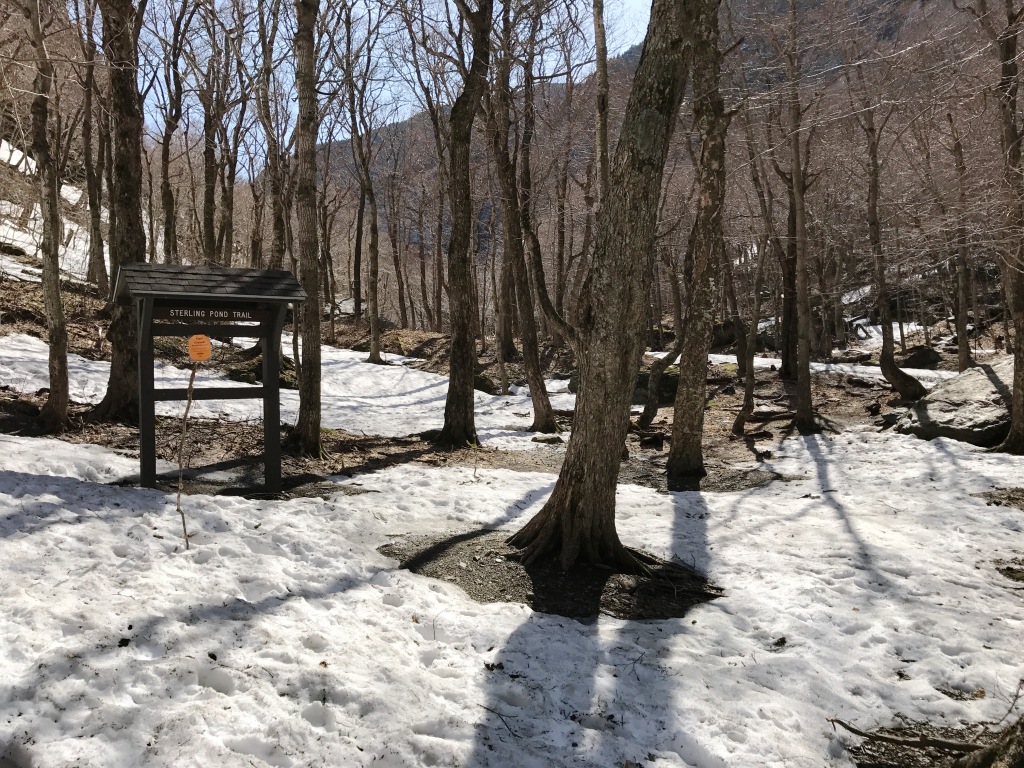
The photo below shows the sign at the beginning of the Sterling Pond Trail. While the trail is open in winter, summer and fall, it is closed in the spring until the snow melts and the ground dries out.


King Rock is next to the road a short ways down the Stowe side:


A bronze plaque on the rock, to the right of and above Nancy, says:

King Rock

6000 tons
Fell From the Side of
Mt Mansfield Spring of 1910

Tablet Placed By
Mrs. C.F. Eddy
And Womens Club of Stowe
1941

One of the notable rock formations in Smugglers Notch is the Hunter and His Dog, visible in the photo below:


A prominent feature in the Notch is Elephant's Head:


To my knowledge the best reference on the history of Smugglers Notch is Mansfield: The Story of Vermont's Loftiest Mountain, by Robert L. Hagerman (Essex Publishing Company, 1971):


Chapter 7 is about Smugglers Notch. (There was a second edition of this book, which I don't have, published in 1975.)

The snow was melting everywhere on our walk today, as in this waterfall beside the road on the Cambridge side:


Saturday, April 15, 2017

Schoodic Peninsula


Schoodic Peninsula is part of Acadia National Park on the coast of Maine. The main part of Acadia National Park is on Mount Desert Island, accessible by a short bridge from Trenton. The tourist town of Bar Harbor is also on Mount Desert Island. Schoodic Peninsula is only five miles from Bar Harbor as the crow flies, but 42 miles by road. Although it is the only part of Acadia National Park on the mainland, it is a more remote and less visited section of the park.

We visited Schoodic Peninsula today. It was a beautiful, sunny day with few other visitors. The photo below is at Frazer Point:


This photo is at Schoodic Point, indicated by the "You Are Here" arrow on the map below:


Schoodic Peninsula has been part of Acadia National Park since 1929 but it has been significantly upgraded in recent years.

In 2011-15 an anonymous person(s) purchased 3,200 acres adjacent to the then existing park, constructed hiking and biking trails and a campground, and donated it to the park. Click here for a news release about the grand opening of the Schoodic Woods Campground in 2015.

A former Naval station was added to the park in 2002 and renovated into the Schoodic Education and Research Center (SERC), operated jointly by the Schoodic Institute and the National Park Service:


The photo below shows Rockefeller Hall, just one of many buildings at SERC:


In 2000 the 29-mile long Schoodic National Scenic Byway was established. The rest area at the Taunton Bay entrance to the Scenic Byway in Hancock is new:


We had a delightful lunch at the Pickled Wrinkle in Birch Harbor, just outside the park. What is a Pickled Wrinkle?
Pickled Wrinkles are an old Downeast Maine Delicacy. They are large carnivorous sea snails, or whelks, which are pickled and marketed locally as Pickled Wrinkles. Unlike herbivorous periwinkles, which inhabit tidal zones, wrinkles are larger and inhabit areas below the tide line. Lobster fishermen find wrinkles in traps they haul from the ocean floor. In tough times, wrinkles were relied on to help feed Maine families, and pickling was a great way to preserve the protein packed morsels. At the Pickled Wrinkle, we strive to provide guests with local seafood and produce whenever possible. We have a diverse menu that includes local Pickled Wrinkles when available. Try one if you are brave enough!

Alas they did not have any Pickled Wrinkles available for us to try today, but the crab rolls, seafood stew, and craft beers were excellent.

Sunday, March 12, 2017

Stratton Brook Hut


Today we hiked to Stratton Brook Hut in western Maine near Sugarloaf Mountain. It was a beautiful sunny day, if cold (about 10 F) and windy. The photo above is near the beginning of the hike and shows the Bigelow Range in the background. The photo below is the hut:


Stratton Brook Hut is one of four huts constructed in western Maine in 2008-2012 by Maine Huts and Trails. There may be more huts in the future according to Wikipedia. These are very nice huts, as shown in the photo below. Stratton Brook Hut can sleep 44 people in 10 bunkrooms. We bought lunch at the hut and it was delicious.


Below is the Bigelow Range from a lookout near the hut:


The trailhead for our hike was on ME-27 just north of Sugarloaf Mountain Resort. It was a three mile hike in to the hut on a groomed trail – see photo below:


We saw cross-country skiers, snowshoers (but snowshoes weren't necessary), and fat tire bicycle riders. Motorized vehicles are not allowed except for a snowmobile for the hut crew. Western Maine received heavy snowfalls in February. There had since been warm weather which consolidated that snow, but there was still a lot of snow left – about 1.5 feet of very solid snow in the woods.

When friends and I were winter peakbagging in 1984-1992 there were no trails or huts like these in the woods! We climbed the two Bigelow peaks (Avery Peak and West Peak) on March 7, 1985 on our way home from a multi-day trip to Baxter State Park where we had climbed North Brother.