Wednesday, July 4, 2012

Introduction to SLOW Government

In the previous post I wrote about Slow Food, Slow Money, and Slow Living. In this post I propose a new kind of "Slow."

My day job at Yankee Farm Credit involves financing farmers, which relates to both food and money. In recent years we have been seeing more nontraditional farmers, and I coined the phrase SLO agriculture for Sustainable, Local and/or Organic agriculture. My choice of acronym was a deliberate reference to Slow Food and Slow Money. Later I learned about Slow Living, and that all of these movements are part of the larger Slow Movement.

The philosophy of "Slow" has much to offer. Who doesn't think that modern life is sometimes too fast? But for all that it has to offer, the Slow Movement is missing something. It is missing what I call SLOW Government.

SLOW Government is the opposite of fast government. Fast government seeks to use the power of government to solve more and more of life's problems, resulting in more laws, more regulations, more government programs, more government bureaucracy, more taxes to pay for it all, and more government control over our lives.

SLOW Government first asks the question: Is this a necessary and proper function of government? In a country founded on the principle of limited government, this is a question that we too often fail to ask. SLOW Government recognizes the importance of culture and society outside of government.

The inspiration for SLOW Government came from one of the principles of Slow Money: "There is such a thing as money that is too fast, companies that are too big, finance that is too complex." (source) I believe that there is such a thing as government that is too fast, too big, and too complex.

A good way to think about SLOW Government is as an acronym, which is why it is capitalized:

S is for Sustainable. Government should be financially sustainable. Current policies are not sustainable. Cash outflows cannot indefinitely exceed cash inflows. Debt cannot increase without limit. We in the Farm Credit System have some experience in this area. We know that excessive debt causes borrowers to fail. We know that excessive debt causes financial institutions to fail. The Farm Credit System itself has had several near-death experiences in its long and storied history. Excessive debt also causes governments to fail. That is a fate to be avoided at all costs because it leads to great misery.

L is for Local. Government should be as local as possible. Centralized administration is the enemy of democracy. Alexis de Tocqueville made this observation in the 1830s in his famous book Democracy in America. On my employer's blog I have written two posts about Alexis de Tocqueville's views on the importance of local government, using New York and China as examples.

O is for Organic. The economy should be as organic as possible. Government should allow the economy to develop naturally, without being forced or contrived. Government's management of the economy should rely as little as possible on subsidies, mandates, grants, tax incentives, stimulus spending, etc. Such artificial devices confuse the price signals that are necessary for the economy to work. Such artificial devices also lead to crony capitalism, which is to be avoided because it causes citizens to lose faith in both business and government.

W is for Wise. Government should be wise. Lao Tzu, the founder of Daoism, said: "To attain knowledge, add things every day. To attain wisdom, subtract things every day." (source) Our government has had so many things added to it that it has become unmanageable. It has become unwise. No one can understand the Byzantine complexity of the endless laws, regulations, programs, agencies, departments, boards, etc. that constitute our government. We need to subtract things from government until it is once again manageable and wise.

One of the intellectual fathers of the Slow Movement is Henry David Thoreau. His influential 1849 essay "Civil Disobedience" begins with this sentence:
I heartily accept the motto,—"That government is best which governs least;" and I should like to see it acted up to more rapidly and systematically.

That perhaps overstates slightly what I mean by SLOW Government, but the sentiment is certainly in the right direction. SLOW Government does not mean NO government. It does mean government that is more Sustainable, more Local, more Organic, and Wiser than our current government.

And with this introduction to SLOW Government, I wish you a happy Independence Day!

UPDATE: Fellow Vermonters have taken the bull by the horns on the "S is for Sustainable" aspect of SLOW Government. Biddle Duke, owner and president of the Stowe Reporter, together with friends Rob Foregger, Steve Silverman, Craig DeLuca, Bob Anderson and Jim Del Favero started a movement that went national in August 2012: Fix the Debt. Sign their petition! Click here for the story of how this movement began in Vermont.

UPDATE: Fellow Vermonters have written the book on the "L is for Local" aspect of SLOW Government. In September 2012 Susan Clark, town moderator of Middlesex, and Woden Teachout published Slow Democracy: Rediscovering Community, Bringing Decision Making Back Home. Read their book! "Slow democracy" means local democracy (and more). Vermont town meetings are an example of slow democracy.

Introduction to Slow Living

In this post I introduce the concept of Slow Living. But first I have to talk about Slow Food and Slow Money.

Everyone knows what fast food is. Slow Food is an international movement founded in opposition to fast food. Slow Food grew out of a protest against the opening of a McDonald's restaurant in Rome in 1986. Slow Food promotes food that is enjoyable, good for the consumer, good for the farmer, and good for the planet. "It opposes the standardization of taste and culture, and the unrestrained power of the food industry multinationals and industrial agriculture." The founder of Slow Food is Carlo Petrini of Italy. Today the Slow Food movement includes over 100,000 members in 150 countries.

The Slow Money movement was founded in 2008 by Woody Tasch of the United States with the publication of Inquiries Into the Nature of Slow Money: Investing as if Food, Farms, and Fertility Mattered. Carlo Petrini wrote the Foreword. The Slow Money movement seeks to "connect investors to the places where they live, creating vital relationships and new sources of capital for small food enterprises." In 2010 there was a Slow Money National Gathering in Shelburne, Vermont, which I attended.

The Slow Living movement extends the philosophies of Slow Food and Slow Money:
This simple phrase [Slow Living] expresses the fundamental paradigm shift that is underway in this age. “Slow” encodes the transformative change from faster and cheaper to slower and better—where quality, community and the future matter. It’s about slowing down and becoming more mindful of our basic connection with land, place and people, taking the long view that builds a just, healthy, fulfilling way of life for the generations to come. It is about common good taking precedence over private gain. It is about shifting not just consumption but investment to support the local and regional economy.

Last month there was a Slow Living Summit in Brattleboro, Vermont, which I attended.

More info (all of the above quotes came from these links):

Slow Food: Wikipedia entry, http://www.slowfood.com/
Slow Money: Wikipedia entry, http://www.slowmoney.org/
Slow Living: Wikipedia entry, http://www.slowlivingsummit.org/

Well, this is all very interesting. Who doesn't think that modern life is sometimes too fast? But what I find really interesting is something that is missing.

What is the philosophy of "Slow" missing? See the next post.

Sunday, March 4, 2012

Madonna Vasa Trail

Today we got out hiking for only the second time this winter. It was the first time on snowshoes! It's been a mild winter, with little snow. But we had a good time today. About 30 degrees F, snowing lightly, with about 1.5 feet of snow on the ground where we were.

We hiked part of the Madonna Vasa Trail, which I had never been on before. It's a XC ski trail that was created some years ago (1960s or 1970s?). It runs from one of the parking lots at Smugglers Notch Ski Area (Madonna Mountain) to the Underhill State Park. We hiked from Desjardin Road to Burnor Road.

Here's the crew today:

It wasn't snowing very hard in the photo above. By the time we stopped for lunch, it was snowing harder:

In case you're wondering, the styrofoam cups contain hot chocolate and peppermint schnapps. Do we look happy??

The Madonna Vasa Trail was inspired by the Vasaloppet in Sweden, called the Vasa for short. The Vasaloppet is an annual 90 km XC ski race that was started in 1922 and was in turn inspired by a legendary run by King Gustav Vasa in 1520.

Sunday, December 25, 2011

100 Years Ago and Today


Pager's parents, Joel Kinsley Putnam and Mabelle Butler were married 100 years ago today. The photo above was taken at the farm on their wedding day. No white Christmas that year!

Beth still has Mabelle's wedding dress:


Above Pager celebrated Christmas today with Beth, Emily, Laura and Katie. Below with me, Brian and Geoff:


Beth gave Pager a copy of the new history of Cambridge (Special Places, Special People) by Roberta Marsh, published last month:


A White Christmas

It has been an unusually warm fall. Most of the northern U.S. is not having a white Christmas this year. We do not have a lot of snow here, but we are fortunate to have a white Christmas. Yesterday, the day before Christmas, was a beautiful, sunny day. We had 2-3" of snow in our backyard:


Today, Christmas Day, it snowed:


 By evening we had another 6" of light, fluffy snow.

Saturday, December 24, 2011

Laraway Mountain

Today was a beautiful winter day. We climbed to the lookout on Laraway Mountain on the Long Trail in Waterville. On the trail up:


Mt. Mansfield from the lookout:


Brian and Laura at the lookout:


Laraway Mountain is known for its south-facing cliffs just below the lookout. Giant icicles form on the cliffs in the winter. Hiking out under the cliffs:


There was 3-4" of snow. We didn't need snowshoes, but it was a little icy. Yaktrax or MICROspikes were helpful. It was a cool day, with temps in the single digits above zero Fahrenheit. We saw only one other set of tracks all day. Soon after crossing the big brook on our way up we met the person who had made those tracks, a rabbit hunter.

On the trail down as the sun set:


The best day in winter is better than the best day in summer!

Sunday, November 13, 2011

Angels Landing

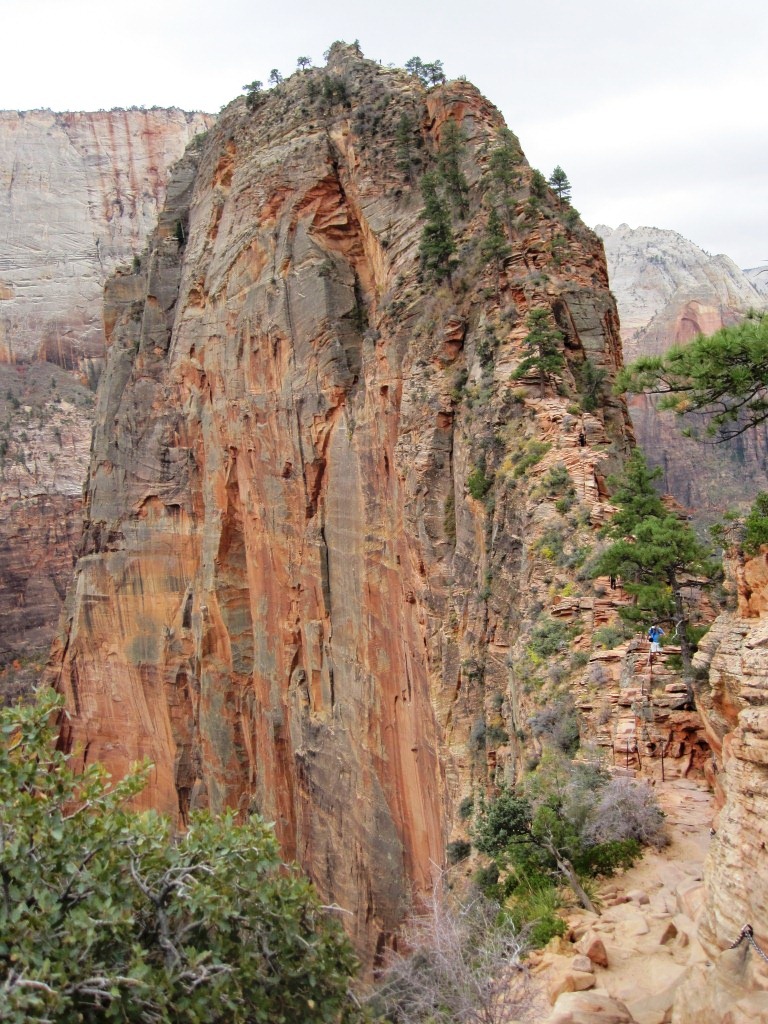
Angels Landing is a 5785 foot peak in Zion National Park. The climb is a popular yet challenging hike. It is 2.5 miles up, with an elevation gain of about 1200 feet. The peak from the valley floor:


The first two miles are paved. The initial climb goes up a series of switchbacks on the south side:


Then the trail levels out as it passes between two peaks:


The paved trail then continues up an amazing series of switchbacks known as Walter's Wiggles:


Scout Lookout is at the top of Walter's Wiggles. Here the paved trail comes to an end. The trail now leads to the summit from the north across a narrow ridge. In a few places the trail is only 2-3 feet wide. There are chains to grasp in many places.


We made it!


Looking down on the Organ and the Virgin River:


Looking down on the Big Bend parking lot (the Organ is just to the right outside the photo):


Looking north toward the Temple of Sinawava and the Narrows:


Looking south down Zion Valley:


We hiked from Zion Lodge, visible in the photo above if you magnify it. A super hike!

Sunday, September 11, 2011

A look back at 9/11 and blogging

Today is the 10th anniversary of the 9/11 attacks. Those attacks helped fuel the rise of blogs.

In April 2002 we visited New York City. It was the first time I had ever been in New York City except in airports and train stations. We went specifically to see Ground Zero. (And also the play QED at the Lincoln Center starring Alan Alda as Richard Feynman.) It was after returning from that trip that I discovered blogs, as I wrote about in this post.

In that post I wrote about two bloggers, Megan McArdle and Glenn Reynolds. Both are now well known bloggers. Megan McArdle blogs at The Atlantic. Glenn Reynolds blogs at Instapundit.

Megan McArdle started blogging in November 2001. She joined Mindles H. Dreck on a blog called Asymmetrical Information. (Mindles H. Dreck is undoubtedly a pen name. I don't know anything about him or her.) Dreck started the blog in October 2001. From Dreck's first post on 10/2/01: "About me: I'm in the money management business. My offices are a few blocks from the former World Trade Center. Like many 'warbloggers' I read, my proximity to this historic event is one of the reasons I'm recording my thoughts." (source, scroll to bottom)

Ms. McArdle's first posts were on 11/23/01, under the pen name Jane Galt. From one of her posts that day:

Now to introduce myself. I am, it seems, the epitome of our new century. I'm 28, just graduated from one of the top business schools in the world, and just had my job offer rescinded by a management consulting firm. In the interim, I have obtained a job with a construction company working on the WTC disaster recovery site. No, I don't work on "the pile" (as it is known here, despite the fact that they are already working below ground level) -- I work in a trailer across the street, doing everything from handing out security passes, to database design, to typing letters. Unfortunately, I can't offer any great insights, or even good gossip, about the site -- first, because they don't tell me anything, and second, because relating what I do hear could cost me my job. So no great insights. But possibly interesting trivia.

In my post referenced above I quoted from her blog post on 4/27/02 when she wrote about having been at the WTC recovery site for seven months, and asking "do you remember?" about things that had happened during those seven months.

Glenn Reynolds starting blogging in August 2001, one month before 9/11. His blog took on a new focus after 9/11. He recently looked back at that experience. Start with this short post that he published last night. Then read this article at knoxnews.com posted yesterday: Attacks gave rise to Instapundit blog. And finally watch the 5 minute video by Glenn Reynolds at the bottom of the knoxnews article.

From the knoxnews article:

In an August video marking the 10th anniversary of his blog, Reynolds said, "The beauty of blogging goes on, as the kind of technology that made it possible for me to start Instapundit makes it possible for people to do all kinds of independent punditry and journalism today."

And that may be the most unintended of consequences of the terrorists whose aim was to strike fear in the hearts of Americans.

P.S. Happy birthday, Brian!

UPDATE 9/12/11: Megan McArdle posts some thoughts about the events of 9/11/01. "Without 9/11...I would not have started blogging."

Sunday, February 6, 2011

Douglas Adams on Money

Douglas Adams was brilliant.

I have been rereading his 1998 talk "Is There an Artificial God?", published in The Salmon of Doubt. (See also my earlier posts on the book and the talk.)

Here's how the talk came about. Douglas Adams was invited to be a speaker at a conference titled: Digital Biota 2 - The Second Annual Conference on Cyberbiology at Magdalene College, University of Cambridge, England. He declined to give a speech, feeling that he was an amateur among luminaries. But he did attend the conference and he agreed to be put on the agenda for a "debate." When it came time for his "debate," he stood up with no prepared notes and talked extemporaneously for over an hour, basically proposing a debate over the question: "Is There an Artificial God?"

It was an amazing performance. Fortunately someone made an audio recording, so that his talk was preserved and later transcribed. At the first link in this post you can find a link to the audio recording where you can hear both Adams himself and the audience reaction.

This captivating talk wove together concepts from science, religion, economics, agriculture and feng shui, all wrapped up in a story about the Four Ages of Sand. He brought all of these disparate themes together into one simple principle:
Anything that happens happens.

You need to read the talk to understand what he meant by that, but he believed that this principle "is arguably therefore the prime cause of everything in the universe. Big claim, but I feel I'm talking to a sympathetic audience." His talk was a tour de force, all the more so because it was off the cuff.

In this post I want to focus on what Douglas Adams said about money:
Money has no meaning outside ourselves; it is something we have created that has a powerful shaping effect on our world, because it's something we all subscribe to.

In his view, the concept of religion is the same. Now you can see how he came to include the topic of economics in a talk titled "Is There an Artificial God?"

Adams does not argue that we should get rid of either religion or money. On the contrary, he acknowledges how incredibly useful they both are. The example he uses to support the usefulness of religion involves agriculture, which is how that topic got into his talk.

That's about all that Adams says about money, but I think he could have said something additional that is interesting.

Recall his Four Ages of Sand; that is, sand to make glass lenses, silicon chips and fiber optic cable:

1. Telescopes - We discover the outer universe.
2. Microscopes - We discover the inner universe.
3. Computers - We discover computation.
4. The Internet - We discover new ways of communication.

All of Adams' major points revolve around the first three ages, especially the Third Age where we learn that complexity can arise from simple processes repeated over and over. He actually forgot to talk about the Fourth Age until someone asked a question about it. In his response to that question he talked about four modes of communication:

1. One-to-one
2. One-to-many
3. Many-to-one
4. Many-to-many

One-to-one communication needs no explanation. One-to-many communication is mass media. I'll say more about many-to-one communication below. Adams' point was that many-to-many communication is new in the world, made possible by the Internet, the Fourth Age. We don't know what changes this will bring to our world, but they are likely to be profound, just as the introduction of one-to-many communication brought profound changes. Think about the effect on history of the printing press, radio, and television.

Adams gave only one example of many-to-one communication:
Then there's many-to-one; we have that, but not very well yet, and there's not much of it about. Essentially, our democratic systems are a model of that, and though they're not very good, they will improve dramatically.

He did not elaborate on how he thought our democratic systems would improve dramatically, but the point I want to make is about something else. I think he overlooked something. I think he missed another important example of many-to-one communication: markets.

Think about the law of supply and demand. Prices adjust so that the amount supplied (at that price) equals the amount demanded (at that price). The price mechanism is what allows the efficient allocation of scarce resources. Prices serve to communicate information between buyers and sellers.

I suppose we could think of markets as many-to-many communication, since there are usually many buyers and many sellers. But I find it useful to think of markets as many-to-one communication. The many (buyers) are communicating useful information to the one (each seller). What kind of useful information? Producers are one example of sellers. The price they can obtain for the products they sell communicates useful information about how much to produce. If the price is high and the producer therefore realizes a profit, the producer will tend to produce more, and so on.

There are two important similarities between democratic systems and markets. In both systems, the many communicate to the one by voting. In democratic systems we vote with ballots. In markets we vote with our purchasing decisions.

Another similarity is that both systems operate well only with liberal quantities of freedom. It is not a coincidence that both democratic systems and markets increased in importance in the world as freedom became more prevalent. The year 1776 was a seminal year for both systems, with the adoption of the U.S. Declaration of Independence and publication of An Inquiry into the Nature and Causes of the Wealth of Nations by Adam Smith.

Douglas Adams said "there's not much of it about" meaning many-to-one communication. If democracy is one's only example, that is true. The amount of information transmitted from the many to the one in a democratic voting system is limited. Not everyone votes, ballots have limited choices, and votes are counted only once every few years. Much more information is transmitted from the many to the one in a market. Participation is broader, choices are more extensive, and votes are counted continuously.

Markets are a wonderful example of many-to-one communication. I would argue a better example even than democracy. And what is necessary to make markets work? Something that:
has no meaning outside ourselves; it is something we have created that has a powerful shaping effect on our world, because it's something we all subscribe to.

Money.

Friday, December 24, 2010

Jon Stewart on Money

Jon Stewart has some fun with the topic of money:

The Daily Show With Jon StewartMon - Thurs 11p / 10c
The Big Bank Theory
http://www.thedailyshow.com/
Daily Show Full EpisodesPolitical Humor & Satire BlogThe Daily Show on Facebook

Jon Stewart makes fun of Ben Bernanke of the Federal Reserve (Fed) for giving different answers at different times to the question: is the Fed printing money?

Jon Hilsenrath of the Wall Street Journal sorts it out: Is the Fed Printing Money?

Mr. Hilsenrath talks about reserves, which is money that banks have on deposit at the Fed. He mentions that reserves have increased from $33B to $1T, an increase of more than 30 times, in less than two years.

A graph makes his point even clearer (source):

Clearly something dramatic changed with the financial crisis of 2008.

It's good that commentators like Jon Stewart question the Fed's actions. If the Fed doesn't get this right, it could have significant adverse consequences for the economy.

Friday, November 26, 2010

Europe Vacation - Intro Post

We recently returned from a wonderful vacation in Europe. The reason for traveling at this time was to visit Laura, who is spending a semester in Copenhagen. Emily also joined us for the entire two weeks, and Brian was with us for the first week. It was the first time that we have all vacationed together in perhaps ten years.

We did and saw too much to blog about completely. But this post contains links to eight other posts that capture some of the highlights.

The biggest highlight, of course, was seeing three special families.

The places we stayed were Copenhagen, Bergen, Drammen (with a day trip to Oslo) and Bondues (with a day trip to Paris).

And one of the delightful discoveries of the trip was the beer!

All of the posts this month are about our vacation, so another way to navigate through our vacation is to use the Blog Archive to look at the posts for November 2010.

Beer

One of the great things about our trip to northern Europe was the terrific beer:

The photo above was from the BioMio organic restaurant in Copenhagen where we had a variety of bottled and draft beers, including Ørbæk Fynsk Forår, Ørbæk Dark Horse, Økologisk Classic, and others.

In Copenhagen we toured the Carlsberg Visitors Centre. While their main brands include Carlsberg, Tuborg and Jacobsen, the tour included the largest collection of unopened beer bottles in the world. There were 16,006 bottles on display:

The bar at the end of the tour had some more recent brews, which of course we sampled.

In Bruges, under the awning at Le Panier d'Or (and while it rained outside), we enjoyed Kwak beer in special glasses. Shown below are the small and medium sizes. There was also a large size that I did not see. The other two beers on the table were Leffe Blonde, another excellent beer from Belgium.

Another favorite Belgian beer was Grimbergen, also usually served in special glasses:

In Lille we enjoyed Rince Cochon (rinse the pig):

Drammen is home to the oldest brewery in Norway, Aass, whose beer we enjoyed. On the streets of Drammen I saw something that I had never seen before—a bulk delivery beer truck!

In Bergen we enjoyed Hansa beer. We also enjoyed ciders, which are much different in Europe than in the U.S.

Return to intro post.

UPDATE 12/29/10: Richard Feynman said: "All life is fermentation." Can be found in Six Easy Pieces, p. 66.