Friday, January 1, 2021

Runaway Pond

Vermont State Route 16 north of the Greensboro-Glover town line is also known as Dry Pond Road. Five miles south of Glover is the rest stop and picnic area shown above. The historic marker tells the story:

RUNAWAY POND

On this site, on June 6, 1810 settlers dug an outlet to the north from what was then known as Long Pond. The retaining bank collapsed, causing all water from the 1.5-mile long pond to be discharged toward Barton River, and on to Lake Memphremagog, with extensive damage to the countryside, but no loss of life.

The plaque in the photo below adds more details:


LONG POND / RUNAWAY POND / DRY POND

In 1810 the water level of Long Pond was 70 feet above this marker and the water flowed south into Greensboro and the Lamoille River.

Needing more water to power Aaron Willson's grist mill in Glover, 60 men and boys dug a ditch on the north shore (about .5 miles north of here) to cause the water to flow into the Glover/Barton River.

Due to the quicksand in the earth, the entire hillside washed away and the pond "ran-a-way" discharging its billion gallons of water toward the mill in 1.5 hours.

Spencer Chamberlin raced ahead of the wall of water for 5 miles and saved the miller's wife.

Glover Historical Society 1996

It was thought-provoking to stand at that picnic area, look at the steep hillsides surrounding the narrow valley, and contemplate how they once contained a 70-foot deep pond that drained in just 1.5 hours.

Northeast Kingdom Adventures: Follow the link for the introductory post about this series and a list of all the posts in the series.

Camp Wapanacki


Camp Wapanacki was originally a fishing camp. The historic Trout Lodge, on the edge of beautiful and remote Wapanacki Lake, is said to have hosted many illustrious guests in the early 20th century, including Calvin Coolidge.

Dr. Merle Frampton of New York City and his wife, Iris, purchased the property in 1937 and the following year they established the first camp in the nation for blind and visually impaired children. The New York Institute for Special Education took over camp operations in 1942. Dr. Frampton served as director of the Institute until 1971. See this 1988 article in the New York Times for more information about this phase of the camp.

After operating as a summer camp for blind and visually impaired children for more than 50 years, Camp Wapanacki was sold in 1991 to the Girl Scout Council of Vermont and it became a beloved Girl Scout Camp. Our daughters spent many summers there as both campers and counselors.

The Girl Scouts sold the camp in 2014. Today the camp is privately owned and cabins are available to rent. See Camp Wapanacki, Wapanacki, and Airbnb (the link is to the former camp director's office, one of several cabins available on the property).


The Trout Lodge and Wapanacki Lake are not visible from the road, where the photos in this post were taken. The text of the historic marker in the photo at the top of this post can be found at Vermont Roadside Historic Markers (search for Camp Wapanacki). Other links I found about the history of the camp:
Camp Wapanacki is in both Hardwick and Wolcott. The usual approach is from Hardwick. The historic marker is on the Hardwick-Wolcott town line.

Northeast Kingdom Adventures: Follow the link for the introductory post about this series and a list of all the posts in the series.

Thursday, November 26, 2020

Thanks to Vermont


Thanks to Vermont was a film produced in 1955 by the Vermont Department of Agriculture and the Vermont Development Commission to promote Vermont farm products.

The scene is set on Thanksgiving Day in a typical Vermont home, the mother preparing the turkey and father trying to sneak a taste. After he is shooed out of the kitchen, he sits down in his easy chair, lights his pipe, and commences to think about all the good agricultural products Vermont has to offer to consumers both inside and outside the state.

This 31-minute video is a fascinating look at the state of agricultural technology 65 years ago. In the dairy industry, that was just prior to the introduction of bulk tanks. The dairy industry still used 10-gallon milk cans. Tractors had completely replaced horses in the fields, but not yet in the woods. Maple sap was still collected in buckets and horse-drawn gathering tubs. Today's pipelines came decades later. Other farm products featured in the video include eggs, turkeys, apples, potatoes, sweet corn, and strawberries. The film also shows haying (both baled and loose), cheesemaking, and agricultural fairs.

Thanks to Guy Page for bringing this video to my attention. And thanks to the Vermont Historical Society and the Vermont State Archives & Records Administration for digitizing the original film and preserving it at the Internet Archive. Here is the link again: Thanks to Vermont. Note that audio does not begin until 48 seconds into the video.

Happy Thanksgiving!

Sunday, September 13, 2020

Shooting Stories


This summer I have noticed several stories online about first-time shooters.

Blogger Ann Althouse wrote about shooting a gun for the first time in June. There is a short video at the link. Ms. Althouse looks pleased with her bullseye!

Ann Althouse is a retired law professor living in Madison, Wisconsin, where she taught at the University of Wisconsin Law School for 32 years. Bio here. Althouse is a popular blog with an active commenter community. In the comments, Ms. Althouse reveals that she shot three guns that day.

The Denver Post reported in August that: Some women are opting to carry guns on Colorado trails to stay safe. The article stresses the importance of proper training. (Article found via Althouse.)

Closer to home, Guy Page recently wrote in Vermont Daily and True North Reports about women in Vermont learning to shoot from Major Ted Tedesco, USMC (Ret).

I encourage people to learn to shoot guns safely and responsibly, and I am not alone. Guy's articles prompted me to share with him the following story about Vermont Senator Patrick Leahy:

“Senator Leahy was a top shooter on the rifle team at Saint Michael’s College when he was an undergraduate. In 2008 he was being inducted into the Vermont Agricultural Hall of Fame in a luncheon ceremony at the Champlain Valley Expo in Essex. I found myself standing next to him in the buffet line, and we started talking about our common experiences on college rifle teams (some 16 years apart – he graduated in 1961, I graduated in 1977). He remembered that experience fondly, and he told me that he still enjoys shooting on his property in Middlesex. He also told me something that I didn’t know before, that he is legally blind in one eye. He thought that helped him be a better shooter. As we parted, he said:

“Everyone should learn two things. They should learn how to swim, and they should learn how to shoot a gun.”

I previously wrote on this blog about my experience on the University of Maine Rifle Team – the Black Bears.

Guy Page kindly reprinted my story about Senator Leahy in Vermont Daily and True North Reports. Full disclosure: Guy is a friend and relative. I've known him since we were boys.

I got to know Senator Leahy when I was CEO of Yankee Farm Credit. For example, see:

All three shooting stories at the beginning of this post, from this summer, are about women. When Senator Leahy was on the Saint Michael's College rifle team, it was all men. The University of Maine rifle team was all men in its early days, but became co-ed my freshman year.

The photo at the top of this post is the University of Maine rifle team in 1977, my senior year. I am standing in the back, fourth from the left, wearing glasses. The sign over us shows the years that the University of Maine rifle team was New England Champions: 14 of the 18 years from 1959 to 1976, including three of the years when Senator Leahy was in college. In 1977 we were undefeated (18-0) and again New England Champions.

Sunday, June 7, 2020

Cheese Tasting Event


Jasper Hill Farm held a virtual cheese tasting event on June 4. It was terrific! Cheesemaker Mateo Kehler and scientists Dr. Rachel Dutton and Dr. Ben Wolfe talked about the art and science of cheese, especially the five delicious cheeses in the tasting kit:
  • Moses Sleeper
  • Willoughby
  • Highlander
  • Landaff
  • Bayley Hazen Blue
Mateo was broadcasting from the Cellars at Jasper Hill Farm where cheese is cave-aged under carefully controlled conditions in underground vaults. He showed us a lot of cheese and some of the aging process (affinage), including a robot for washing, brushing, and turning cheeses. 

Dr. Ben and Dr. Rachel talked about the microbiology of cheese. As Mateo explained:

It's the microbes that really do the hard work of transforming and unlocking the flavor potential of each of these cheeses.

Dr. Ben described the microbial process as "delicious rot."

We learned about the importance of the rind, and three different kinds of rinds:
  • Bloomy rind (inoculate with mold)
  • Washed rind (wash with salt)
  • Natural rind (do very little)
Should you eat the rind? It is definitely edible. Dr. Rachel: "If it's not a wax rind, then you should taste it, because you might like it." Mateo and Dr. Ben strongly agreed! A bloomy rind or a washed rind, especially, will often be delicious and enhance the flavor of the cheese.

There was much more about science and tasting notes. It was a delightful hour and a half. The event was advertised as the first of "an interactive online lecture series." More than 200 people participated in this Zoom presentation. Many participants submitted questions and comments via chat, which enhanced the experience.

The photo below shows the computer and cheese board at our house at the beginning of the event:


Jasper Hill Farm in Greensboro, Vermont, was a former dairy farm that brothers Andy and Mateo Kehler and their wives purchased in 1998. They broke ground for the Cellars in 2006. Since then the business has grown significantly and they have won many cheese awards. See their history here.

Dr. Rachel Dutton researches the microbiology of cheese in her laboratory at the University of California San Diego. See The Dutton Lab @ UCSD.

Dr. Ben Wolfe researches the microbiology of cheese and fermented foods in his laboratory at Tufts University in Massachusetts. See The Wolfe Lab @ Tufts University.

The collaboration between the scientists and Jasper Hill Farm is discussed in this article: The kings of artisanal cheese wear lab coats. The Kehler brothers are not only dairy farmers. As cheesemakers, they also farm microbes.

In the spirit of full disclosure, I should note that I have connections with some of the people mentioned in this post beyond simply being a cheese consumer. Before I retired at the end of 2016, I got to know Mateo and Andy Kehler through my job at Yankee Farm Credit (link). Completely coincidentally and unrelated to that connection, a few months ago our daughter became a post-doctoral researcher in The Wolfe Lab @ Tufts University (link).

Nevertheless I did not learn about this "interactive online lecture series" through any of those connections. I learned about it because I am on the mailing list for Jasper Hill Farm. Anyone can sign up for that mailing list here (scroll down to "Join the Herd").

Enjoy good cheese!

Sunday, May 31, 2020

Smugglers Notch Rock Slide

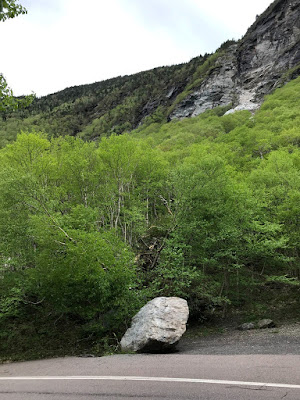
The road through Smugglers Notch was briefly closed today due to a rock slide that damaged at least one car pretty significantly. No one was injured to our knowledge. The photos in this post were taken at about 2:30 PM after the road was reopened.

The photo below shows a large rock partially in the road:


The photo below shows a slightly smaller rock on the edge of the road.


The second rock significantly damaged the rear end of a parked car. WCVB in Boston has photos of the damaged car here, courtesy of the Vermont State Police. Thankfully no one was in the car.

The photo below is another view of the second rock, and shows both where the rock slide started high on the mountain and the path where this rock rolled out of the trees.


The photo below shows both rocks. The rock in the distance is the larger rock that is partially in the road, and the closer rock is the one that hit the car that was parked on the side of the road. The rock slide occurred just on the Stowe side of the height of land.


We drove through Smugglers Notch twice today, the first time around 11:30 AM. The rock slide had recently happened. We saw the damaged car as shown in the WCVB photos and there were rescue vehicles on the scene. The road was not yet closed. There was a trooper from the Vermont State Police directing traffic, and things were so exciting that I did not get any photos at that time.

Saturday, May 30, 2020

COVID-19 in Other States

The previous post included data about the prevalence of COVID-19 in Vermont and I concluded: "At least for the present, COVID-19 is fading away in Vermont." What about other states, and the country in total?

The Washington Post has statistics for all 50 states, the District of Columbia, U.S. territories, and the U.S. in total. No subscription is required to access this page:


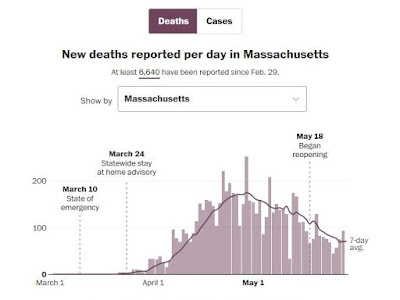
The statistics are presented graphically in a manner similar to my previous post about Vermont: cases and deaths, per day and the 7-day average. Following are graphs for the United States in total. Both cases and deaths are trending down:


(Click on any image to enlarge. Sreenshots captured on May 29.)

Total deaths in the United States recently passed the sad milestone of 100,000. In Past Pandemics I noted that U.S. deaths were estimated to have been 100,000 from the 1968 flu pandemic, 116,000 from the 1957 flu pandemic, and 675,000 from the 1918 flu pandemic. U.S. deaths per 100,000 population (rounded to the nearest multiple of 10):

 1918 flu 
 650 
 1957 flu
 70 
 1968 flu
 50 
 COVID-19 to date 
 30 

What about our neighbors? Here in Vermont we get a lot of visitors from neighboring states. Following are COVID-19 deaths to date per 100,000 population (rounded to the nearest multiple of 10):

 Massachusetts
 100 
 New Hampshire     
 20 
 New York
 150 
 Vermont
 10 

New York and Massachusetts are significantly worse than the national average of 30, but both states are trending down for both cases and deaths:


Here is the link again if you are interested in data for other states:


Friday, May 29, 2020

COVID-19 in Vermont

We are nearly three months into the pandemic. How are we doing? At least for the present, COVID-19 is fading away in Vermont.

The following graph shows COVID-19 cases in Vermont, both new cases reported each day from March 1 through May 28 and the 7-day average (click on any image to enlarge):


There was 1 new case yesterday and there have been 975 cases to date.

The following graph shows COVID-19 deaths in Vermont:


There have been 55 deaths reported, the last one on May 24.

The first graph shows the results of testing. It should be noted that testing has increased substantially over the period shown in the graph. At the beginning of the pandemic, tests were severely rationed because they were in short supply. Testing capacity is abundant now, and the state is regularly testing 1,000 or more people per day. (link) Yet the 7-day average of positive tests has been below 10 since April 19.

Data for the graphs are from the Vermont Department of Health, but I created the graphs myself so there is room for error there. Readers are welcome to check my work.

For data about other states (especially New York and Massachusetts) see the subsequent post: COVID-19 in Other States.

Wednesday, May 20, 2020

Coronaviruses

SARS-CoV-2. Credit: NIAID-RML

The current COVID-19 pandemic is the first pandemic caused by a coronavirus. What is a coronavirus?

(Two earlier posts may be helpful for background. Past Pandemics is about earlier pandemics caused by influenza viruses and bacteria. Viruses and Bacteria is about the differences between viruses and bacteria.)

There are many, many different types of viruses. Coronaviruses and influenza viruses are two of these many types.

There are many different coronaviruses and many different influenza viruses. Both coronaviruses and influenza viruses are known to infect birds and mammals. Only a small percentage of viruses infect humans. Seven coronaviruses are known to infect humans.

Viruses consist of genetic material (DNA or RNA) surrounded by proteins. They come in many shapes. Coronaviruses are so named because they are roughly spherical with protruding proteins that resemble the solar corona. See the electron micrograph at the top of this post. (source) "Corona" is Latin (and Spanish and Italian) for crown.

Four human coronaviruses are known to cause the common cold. Several different types of viruses cause the common cold: rhinoviruses (30-80%), coronaviruses (about 15%), influenza viruses (10-15%), and other types. (source)

Viruses that cause the common cold are not a big public health concern. The common cold is contagious and annoying, but rarely fatal. Since the turn of the century, however, scientists have identified three new human coronaviruses that cause death in a significant number of cases. The diseases caused by these three new human coronaviruses have been named:
  • SARS
  • MERS
  • COVID-19
SARS and MERS did not rise to the level of pandemics, but what scientists learned from those earlier diseases may help us understand the current COVID-19 pandemic.

SARS (link)

Severe acute respiratory syndrome (SARS) was first reported in 2002 in China. No cases have been reported since 2004. Fewer than 1,000 deaths were reported, mostly in China and southeast Asia, none in the United States.

While SARS was not particularly contagious, it was lethal. The percentage of people diagnosed with the disease who died was 11% – an alarming number. (This is called the case fatality rate.)

The coronavirus that causes SARS is called SARS-CoV or SARS-CoV-1. See the image below:

SARS-CoV. Credit: F.A. Murphy and S. Whitfield, CDC

MERS (link)

Middle East respiratory syndrome (MERS) was first reported in 2012 in Saudi Arabia and Jordan. Like SARS, fewer than 1,000 deaths have been reported, mostly in the Arabian Peninsula, none in the United States.

Fewer people were diagnosed with MERS than with SARS, but the case fatality rate was even more alarming – around 35%. This is a deadly disease.

The coronavirus that causes MERS is called MERS-CoV. See the image below:

MERS-CoV. Credit: NIAID

COVID-19 (link)

Coronavirus disease 2019 (COVID-19) was first reported in China in 2019. It is not as lethal as SARS or MERS, but it is much more contagious. As I write this, nearly 5 million cases have been reported worldwide, and more than 324,000 deaths. (source) (We don't yet know the case fatality rate, however. By definition the case fatality rate cannot be computed until the pandemic is over.)

The coronavirus that causes COVID-19 is similar to the coronavirus that caused SARS, and is called SARS-CoV-2. See the image at the top of this post.

Aside: The image at the top of this post (source) is the same as the image in the post We are in a war (source) except that it is colored differently. Both images are colorized for artistic effect. The viral particles don't actually have the different colors shown. The coloring in this post shows the coronas more clearly. Both images were captured and colorized by the National Institute of Allergy and Infectious Diseases (NIAID) at their Rocky Mountain Laboratories (RML) in Hamilton, Montana, in February 2020.

The common cold, SARS, MERS, and COVID-19 are all infectious diseases caused by coronaviruses that attack the respiratory system. What makes SARS, MERS, and COVID-19 more deadly than the common cold is that the common cold generally attacks only the upper respiratory system (nose and throat), while SARS, MERS, and COVID-19 also attack the lower respiratory system (lungs). In some cases they also attack other organs.

SARS, MERS, and COVID-19 are all new in this century. And they are all thought to have this interesting aspect in common: that they all originated in bats, and were transmitted to humans either directly or through another species.

For MERS the intermediary species was the dromedary camel. (MERS is also known as camel flu.) SARS and COVID-19 are thought to have originated in horseshoe bats. The palm civet is considered a possible intermediary species for SARS, and the pangolin may have been an intermediary species for COVID-19. The diseases may also have passed directly from bats to humans.

Cute animal photos at the end of this post!

I'll stop here and leave you with a few references if you are interested in further research:

For information about the seven known human coronaviruses, see webpages by the Centers for Disease Control and Prevention (CDC) here and here.

For information about the three recent human coronavirus diseases, see the CDC's webpages for: SARS, MERS, COVID-19.

For a discussion about the role of bats, see this article in the Wall Street Journal on 4/09/2020: The Bats Behind the Pandemic. (Very interesting, but probably behind a paywall, sorry.)

For an excellent discussion about SARS, MERS, COVID-19, and coronaviruses in general, listen to this podcast at "This Podcast Will Kill You" posted 2/04/2020:

Episode 43 M-m-m-my Coronaviruses

Transcript here. See Podcast Recommendation on my other blog, The Switchel Philosopher, for background about "This Podcast Will Kill You." This episode was my initial introduction to coronaviruses. Recommended.

COVID-19 Statistics Update

There have been more than 324,000 deaths worldwide (source); approximately 90,000 deaths in the U.S. (source); and 54 deaths in Vermont (source). Comparable statistics for earlier dates: March 26, April 4, April 25.

Cute animal photos follow!

Dromedary camel (source):

Dromedary camel. Credit: Florian Prischl / CC BY-SA

Horseshoe bat (source):

Horseshoe bat. Credit: Aditya Joshi / CC BY-SA

Palm civet (source):

Palm civet. Credit: Praveenp / CC BY-SA

Pangolin (source):

Pangolin. Credit: Piekfrosch / CC BY-SA

Friday, May 15, 2020

Viruses and Bacteria

SARS-CoV-2 virus. Credit: Alissa Eckert, Dan Higgins
CDC PHIL ID#23312

In Past Pandemics I noted that COVID-19 and influenza are caused by viruses, while the Black Death was caused by bacteria. What are the differences between viruses and bacteria? Let's review some basic biology.

Two types of large, complex molecules are found in both viruses and bacteria:
  • genetic material
  • proteins
Proteins are the building blocks of life, and there are many, many different proteins. Genetic material contains the code (the instructions) for making proteins – and for making more genetic material. DNA and RNA are two types of genetic material.

A bacterium is a wonderfully complex thing. It contains not only genetic material and proteins, but also: the molecular machinery for making more genetic material and proteins; the raw materials for making more genetic material and proteins; and other stuff that is outside the scope of this post.

The molecular machinery is itself made of proteins and genetic material, which as noted above are large, complex molecules. The raw materials are smaller, simpler molecules that can be assembled by the molecular machinery into more complex molecules.

A bacterium is a cell. Cells consist of cytoplasm enclosed in a membrane. The genetic material, the proteins, the raw materials, and the molecular machinery all float around in the cytoplasm.

A virus is less than a cell, and therefore smaller and simpler than a bacterium. A virus consists of genetic material surrounded by proteins. That's it. There is no molecular machinery for making more genetic material or proteins. There are no raw materials for making more genetic material or proteins. There is nothing floating around in cytoplasm because there is no cytoplasm.

The parts of a bacterium are dynamic. Things move around. The machinery works. A bacterium is abuzz with activity at the molecular level much of the time. In contrast, a viral particle by itself is static, inert.

A bacterium is sufficiently complex that it can reproduce itself through a process called cell division. A virus cannot reproduce itself. Viruses replicate by invading a cell and hijacking the molecular machinery and raw materials of that cell to create new viral particles. Viral diseases are caused by this invasion of host cells and the release of hordes of new viral particles that then invade more cells.

Are viruses alive? That depends on who you ask and their definition of life. Viruses are not as fully alive as bacteria because they cannot (on their own) manufacture proteins or genetic material, and they cannot self-reproduce.

Both viruses and bacteria come in many shapes and sizes, but viruses are generally much smaller than bacteria. The image at the top of this post is a computer-generated illustration of the SARS-CoV-2 virus that causes the COVID-19 disease. (source) (See The Spiky Blob Seen Around the World for an interesting New York Times article about this illustration.)

The SARS-CoV-2 virus is roughly spherical with a typical diameter of 100 nanometers. In comparison, E. coli is a common bacteria that is rod-shaped with a typical length of 2,000 nanometers and a typical diameter of 500 nanometers. See the scanning electron micrograph below (2 micrometers = 2,000 nanometers):

E. coli bacteria. Credit: NIAID

Not all bacteria are harmful. Many kinds of bacteria are beneficial. For example, a complex ecosystem of gut bacteria in humans (including some types of E. coli) is essential for processing food. On the other hand, all viruses are considered pathogens (disease-causing agents) although only a small percentage of viruses infect humans. Viruses can infect many living organisms, including bacteria. Viruses that infect bacteria are called bacteriophages or simply phages.

Our bodies have many natural defenses against the viruses and bacteria that are human pathogens. We get sick when those defenses fail. (We can also get sick if those defenses overreact, but that topic is beyond the scope of this post.) What does modern medicine have to offer when our natural defenses against pathogens fail?

Because bacteria are more complicated than viruses, there are more ways to attack them. There are many antibacterial drugs, called antibiotics. Penicillin is an antibiotic that kills bacterial cells by attacking the cell wall – a structure present in most bacteria cells, but not in animal cells.

Viruses are simpler than bacteria, and aren't as fully alive, so they are more difficult to "kill." It is not possible, for example, to inactivate a virus by attacking the cell wall, because there is no cell wall. A small number of antiviral drugs exist for a limited number of viruses, but none yet for SARS-CoV-2. Multiple groups of scientists are working on such drugs.

Some viral diseases (and some bacterial diseases) can be prevented (not cured) with vaccines. That subject is outside the scope of this post except to note that no vaccine currently exists for COVID-19. As with antiviral drugs, multiple groups of scientists are working to develop a vaccine.

The common cold is typical of human experience with viral diseases. Humans all over the world would dearly love to find a cure or vaccine for the common cold, which is caused by viruses. But no cures or successful vaccines have been developed. The best we can do is take medicines that alleviate some of the symptoms while the body slowly cures itself if it can.

There is much more to viruses and bacteria, of course. If you are interested in learning more, follow the links in the previous sentence to get started.

A few things to remember from this basic introduction:
  • A bacterium is a cell. A virus is less than a cell.
  • Viruses replicate by invading a host cell and hijacking its machinery to make more viral particles.
  • Antibiotics only work on bacteria. Antibiotics do not work on viruses.

Tuesday, May 12, 2020

Smugglers Notch - 2 days later

We walked on the road in Smugglers Notch today, same as two days ago – see Mother's Day in Smugglers Notch (our daughters joined us on that walk). The road is still closed. Compare the two photos below. They look very similar.

Two days ago
Today

BUT – big surprise! – the road is clear all the way through!! Two days ago most of the road above the gate was snow-covered. Today the entire road is bare. The photo below was taken at the height of land today.


Compare the two photos below, looking down from the height of land toward Stowe. They look very different!

Two days ago
Today

What happened?? Clearly all the snow did not melt, as there is still snow on the side of the road. In fact, the weather has not been particularly warm since Mother's Day. We actually had MORE snow last night – 1" of new snow at home and likely more in the Notch.

No, it wasn't Mother Nature that cleared the road. It was this VTrans critter, at least in part, currently resting in the parking lot near the height of land:


Perhaps VT-108 through Smugglers Notch will open soon! Last year the road opened on May 15, the year before on May 10. (link)

The waterfalls were even more beautiful, and active, today than on Mother's Day:


Update 5/14: The road opened today! See the Facebook post by VTrans here and WCAX article here.

Sunday, May 10, 2020

Mother's Day in Smugglers Notch

Pre-coronavirus I entered a contest to guess when the road through Smugglers Notch would re-open this spring. That was during the local WinterFest celebration the weekend of January 25-26. Seems like a long time ago.

My entry was noon on May 10. At the time I did not realize that it was a Sunday (an unlikely day of the week for the Vermont Agency of Transportation to re-open the road) or that it was Mother's Day. In any event, how did I do?

WRONG!!


The photo above was taken at noon today. (Click on any photo to enlarge.)

The entire northeast was hit with a snowstorm the night before last. Some areas received several inches. (link) It is not unprecedented to have snowstorms here in May, but it is unusual. In recent decades, significant May snowstorms have occurred in 1977, 1996, and 2002. That might not be an exhaustive list.

We had 2" of snow on the ground at home (elevation 680') yesterday morning, but it was all gone by last night. The photo above was taken where VT-108 through Smugglers Notch is closed on the Cambridge side. At that elevation (1700') there was still snow in the woods today, but not on the road. We did not have to walk far up the road, however, before it was covered with snow. See photo below:


At the height of land on VT-108 (elevation 2175') there were three or four inches of snow on the road. We celebrated with hot chocolate flavored with Vermont Ice Maple Crème. A tasty beverage for honoring Mother's Day this year! (Ambient temperature 36°F.) And the mother among us said she liked a laughing man:


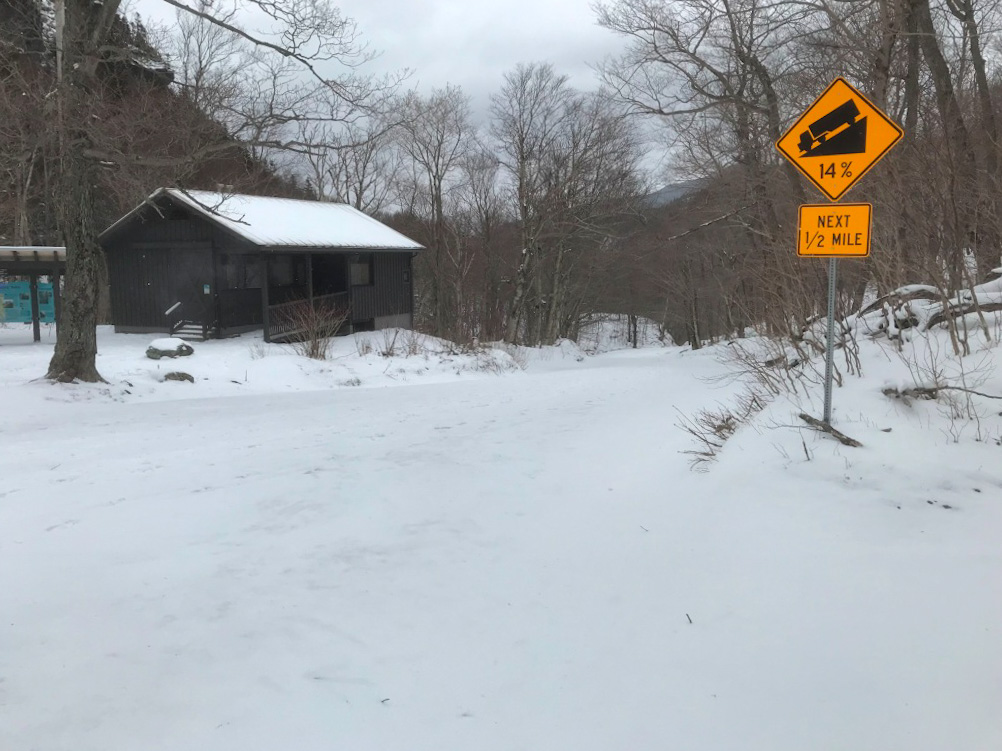
The photos below from the top of Smugglers Notch show the views looking down on the Stowe side (16% grade) and the Cambridge side (14% grade).


(It is ironic that the signs show a tractor-trailer. Tractor-trailers are prohibited from Smugglers Notch because the road is steep and there are narrow hairpin turns around and between boulders. See this news article from last May about tractor-trailers getting stuck every year: Stuck trucks botch Notch despite VTrans bans, fines and signs.)

The waterfall on the Cambridge side was beautiful. The photo below shows ice on the trees and rocks near the waterfall.


This video shows the waterfall:


It is interesting to compare this post to the photos and video in my post on April 24, 2017: Smugglers Notch.

So when will VT-108 through Smugglers Notch re-open? My new guess is the Friday before Memorial Day. That is 12 days away.

Update 5/14: The road opened today! See my follow-up post on 5/12 (Smugglers Notch - 2 days later) and the Update at the end of that post.