Tuesday, June 4, 2019

Smithsonian Institution


The Smithsonian Institution is one of the treasures of Washington. It is huge, consisting of "19 world-class museums, galleries, gardens, and a zoo," the majority on or near the National Mall. The photo above shows the headquarters, the Smithsonian Castle. In the foreground is the Enid A. Haupt Garden, one of many beautiful Smithsonian Gardens.

British scientist James Smithson bequeathed his estate "to the United States of America, to found at Washington, under the name of the Smithsonian Institution, an Establishment for the increase & diffusion of knowledge." Smithson died in 1829; in 1846 President James Polk signed legislation establishing the Smithsonian Institution. Construction of the Castle began in 1847 and was completed in 1855.

We visited the Castle and four Smithsonian museums plus the National Gallery of Art (not part of the Smithsonian). We saw only a fraction of each museum, and could have spent hours more in each. To keep this post to a reasonable length, I'll mention only one item from each museum.

National Museum of the American Indian


At the time of European contact with the Americas, the greatest empire in the Americas was the Inka Empire. It started around 1200 AD and grew rapidly until by the early 1500s it stretched along the Andes Mountains of western South America from Columbia to southern Chile. The Great Inka Road: Engineering an Empire is a special exhibit at the National Museum of the American Indian that tells the story of this empire and the remarkable road system that connected its far-flung regions to the capital of Cusco (in present day Peru). The Great Inka Road or Qhapaq Ñan included some 20,000 miles of roads.
A vast complex of roads, bridges, and other structures, the Qhapaq Ñan was the largest construction in the Western Hemisphere when Inka power was at its height.

Suspension bridges were made of grass. Watch a 3-minute video, narrated by a professor of civil engineering at the Massachusetts Institute of Technology, about the annual rebuilding of the last surviving suspension bridge of this type: Weaving the Bridge at Q’eswachaka. More info here (scroll down).

The Inka were a mountain people. Although their empire extended along the west coast of South America for nearly 4,000 miles, they apparently never took to the sea.

"The Great Inka Road" exhibit nicely complemented the "Exploring the Early Americas" exhibit in the Library of Congress. "The Great Inka Road" exhibit has run since 2015 and will continue until June 2020.

The National Museum of the American Indian has public museums in both Washington and New York City. Senator Daniel K. Inouye of Hawaii was instrumental in the creation of the Washington museum and he spoke at its opening in 2004. See: A Warrior Chief Among Warriors: Remembering U.S. Senator Daniel K. Inouye.

National Museum of African American History and Culture


The National Museum of African American History and Culture is the newest Smithsonian museum, established by Congress in 2003. Groundbreaking was in 2012 and the museum opened to the public in 2016. President Barack Obama spoke at both ceremonies.

Below ground are three levels of History Galleries that tell the story of African Americans from the transatlantic slave trade to today:


The History Galleries conclude with a Contemplative Court (shown above) and this quote from Martin Luther King, Jr.:
We are determined … to work and fight until justice runs down like water and righteousness like a mighty stream.

The phrase "until justice runs down like water and righteousness like a mighty stream" is adapted from Amos 5:24 in the Bible.

National Museum of American History


Perhaps the premier exhibit at the National Museum of American History is The Star-Spangled Banner, which showcases the actual (very large) flag that flew over Fort McHenry during the Battle of Baltimore in September 1814 and which inspired our national anthem. I have already written about the Star-Spangled Banner in my earlier post Evening Parade at Marine Barracks, so I will write here about a different exhibit.

The first automobile trip across the United States was completed in 1903 when H. Nelson Jackson drove from California to New York in 63 days, accompanied by mechanic Sewall Crocker and their dog Bud.


As shown in the diorama above, they spent considerable time pulling the car out of mud holes. The exhibit includes the actual car from this adventure, a Winton touring car. Jackson spent $8,000 to win a $50 bet, but he made headlines all across the country. More info here: Crossing the Country.

H. Nelson Jackson was a doctor and businessman from Burlington, and the car was named "Vermont."

Freer|Sackler

The Freer Gallery of Art and the Arthur M. Sackler Gallery, together called the Freer|Sackler, specialize in Asian art. We toured the special exhibit Empresses of China's Forbidden City, 1644-1912 organized by the Peabody Essex Museum in Salem, Massachusetts, the Freer|Sackler, and the Palace Museum in Beijing, China. This exhibit told the story of the empresses of the last Chinese dynasty, the Qing Dynasty, which ruled China for more than a quarter millennium (1644-1912).

Most of the people in China are Han Chinese, but the rulers of the Qing Dynasty were Manchus. In the Qing Dynasty, the empresses (wife of the emperor) and the empress dowagers (mother of the emperor) wielded considerable power.
Arguably the most powerful empress in Chinese history, Empress Dowager Cixi (pronounced tsz xyi) [1835-1908] dominated the court and policies of China's last imperial dynasty for nearly fifty years.


The exhibit included elaborate garments and artworks. Many of the objects have never been shown outside of China, but the painting of Cixi shown above belongs to the United States:
As a way to polish her image outside China, Cixi invited American artist Katharine A. Carl to create this commanding portrait for display at the 1904 World's Fair held in St. Louis, Missouri. In a strategic diplomatic move, Cixi had this portrait presented to President Theodore Roosevelt, who in turn had it transferred to the Smithsonian.

Quotes are from a sign near the painting. This extraordinary exhibition is only at the Smithsonian March 30-June 23, 2019.

National Gallery of Art

The National Gallery of Art includes two buildings: the neoclassical West Building and the modern East Building. The NGA is on the National Mall and looks like it is part of the Smithsonian Institution, but it is not. It was a gift to the United States in 1937 from Andrew W. Mellon, a banker who was Secretary of the Treasury under Presidents Harding, Coolidge, and Hoover.

Below is a photo of the Alexander Calder exhibit in the East Building.


Washington, DC Trip: Click here for the introductory post about our trip to Washington which lists all of the posts in this series.

Old Post Office Tower


When the Washington Monument is closed, the best view in town is from The Old Post Office Tower at 1100 Pennsylvania Avenue NW, shown above.

The Old Post Office was built in the 1890s, about the same time as the Thomas Jefferson Building of the Library of Congress, as the headquarters of the U.S. Post Office Department as well as the city post office for Washington. The building is located in Federal Triangle, an area bounded by Pennsylvania Avenue NW, Constitution Avenue NW, and 15th Street NW. Federal Triangle contains ten major federal and city buildings, most of which were constructed in the 1920s and 1930s.

This view from the tower is looking southeast along Pennsylvania Avenue NW toward the Capitol:


The view below is looking south to the National Mall. The domed building to the left is the National Museum of Natural History. Note the skylight on the Old Post Office in the foreground.


Looking southwest toward the Washington Monument:


Today most of the Old Post Office is the Trump International Hotel, but access to the tower is maintained by the National Park Service. The photo below is inside the building, looking down into the hotel. The skylight allows natural light into the central atrium.


The photo below is of a poster in the hallways, showing an aerial view of the Old Post Office in September 2016 when the Trump Hotel was completed.


Washington, DC Trip: Click here for the introductory post about our trip to Washington which lists all of the posts in this series.

Arlington National Cemetery


Arlington National Cemetery is the final resting place for more than 400,000 members of the armed services and their families. The cemetery covers 624 acres on the Virginia side of the Potomac River, not far from the Pentagon. In the photo above, the Washington Monument is visible in the distance between the trees.

The land was in the original District of Columbia, but was returned to Virginia in 1846. See this post. The property once belonged to George Washington Parke Custis, grandson of Martha Washington and step-grandson of George Washington. Custis willed the property to his daughter Mary Anna Randolph Custis, who was married to Robert E. Lee. The Lee family left their home at the beginning of the Civil War, and federal troops occupied the property as a camp and headquarters. As Civil War casualties mounted, the property became a burial ground beginning in 1864.

The Tomb of the Unknown Soldier is at Arlington National Cemetery, guarded 24 hours a day every day by the 3rd Infantry Regiment of the U.S. Army (The Old Guard).


The changing of the guard takes place every half hour during the summer, otherwise every hour. Below are photos of this ceremony.


The Tomb of the Unknown Soldier was made by the Vermont Marble Company which has an excellent exhibit at the Vermont Marble Museum in Proctor: The Story of the Tomb of the Unknown Soldier.

Senator Tom Cotton of Arkansas served as a member of The Old Guard in 2007. Last month he published a book about Arlington National Cemetery, The Old Guard, and his experience there: Sacred Duty: A Soldier's Tour at Arlington National Cemetery (review).

Two presidents are buried in Arlington National Cemetery: William Howard Taft and John F. Kennedy. Below is a photo of the Kennedy Gravesite where President Kennedy and Jacqueline Kennedy Onassis are buried. The Eternal Flame burns next to their graves. President Kennedy's brothers Robert Kennedy and Edward "Ted" Kennedy are buried nearby.


On a hill in the cemetery lies Arlington House, originally the Lee family residence and now a National Memorial to Robert E. Lee. It was closed for renovations, reopening in January 2020.


Below is the view from Arlington House looking across the Potomac River to Washington where the Washington Monument and the Capitol Building are clearly visible.


Arlington National Cemetery includes many memorials and notable graves. For example, there are memorials for the Space Shuttles Challenger and Columbia, and Supreme Court Justice Thurgood Marshall is buried there. Many of the grave markers are beautiful works of art. We could have spent several more hours in the cemetery and the visitor center.

Washington, DC Trip: Click here for the introductory post about our trip to Washington which lists all of the posts in this series.

Evening Parade at Marine Barracks


The Evening Parade at Marine Barracks in Washington, DC is a wonderful performance to see. The parade is on Friday evenings in the summer. The photo above shows the parade ground as the sun was setting, about a half hour before the parade began. Marine Barracks, also known as "8th and I" because it is located at 8th and I Streets in the southeast quadrant of Washington, is the oldest post in the Marine Corps, having been established in 1801.

The Evening Parade involved three components:
These units perform many ceremonial functions throughout the year including performances for the President of the United States and guests, and burial ceremonies at Arlington National Cemetery.

The photo below shows the color guard marching in front of the stands:


All units are on the field in the photo below. Band members are in red and white, while the ceremonial marchers are in blue and white. The two bands are marching together here, but sometimes they marched separately or through each other.


Another photo of all units on the field, mostly playing in place this time:


John Philip Sousa was a member of the Marine Band 1868-1875 and its director 1880-1892. He composed many marches including "The Stars and Stripes Forever" – the U.S. National March. Below is a 34 second video of the piccolo obligato in "The Stars and Stripes Forever":


The photo below shows the ceremonial marchers in front of the stands.


Alas, I do not have any photos of the Silent Drill Platoon's precision drills with M1 Garand rifles with fixed bayonets. That occurred too far away from us for good photos. It was spectacular, but we should have brought binoculars for better viewing.

The flag flying above the parade ground was the Star-Spangled Banner, which was the flag flown when the post was established in 1801. The Star-Spangled Banner was the only version of the United States flag to have more than 13 stripes. It had 15 stars and 15 stripes, recognizing the 14th and 15th states, Vermont and Kentucky, and was in use from 1795 to 1818. Subsequent flags reverted to 13 stripes recognizing the original Thirteen Colonies, and added one star for each new state.

The flag was lowered at the end of the performance:


It was the Star-Spangled Banner that was our nation's flag during the War of 1812. It was the Star-Spangled Banner that flew over Fort McHenry during the Battle of Baltimore in September 1814, and inspired Francis Scott Key to write the lyrics of our national anthem.

As noted in earlier posts, the British invaded Washington in August 1814, the month before the Battle of Baltimore, and burned many buildings including the Capitol and the White House. For some reason, the British spared Marine Barracks including the Commandant's House, still standing at the end of the parade ground as shown in the photo below taken before the evening's festivities began.


One of the fun aspects of the Evening Parade at Marine Barracks was that before the parade, the Marines visited with the spectators in the stands. They were impressive young men and women, and they enjoyed visiting with the spectators, especially the many veterans present.

Washington, DC Trip: Click here for the introductory post about our trip to Washington which lists all of the posts in this series.

Library of Congress


The Library of Congress is one of the treasures of Washington. Congress established a library for itself in 1800 when the federal government moved from Philadelphia to Washington. The initial collection was housed in the Capitol, and was mostly lost when the British burned the Capitol in August 1814 during the War of 1812. Congress restocked the collection by purchasing the much larger personal library of Thomas Jefferson, then in his 70s and retired from public service.

Construction of a separate and permanent home for the Library of Congress began in 1890 and the building (pictured above) opened to the public in 1897. The building was named the Thomas Jefferson Building in 1980.

The exterior architecture of the central section was inspired by the Palais Garnier in Paris. The interior is richly decorated with paintings, mosaics, sculptures, and other works of art. Below is one of the marble staircases in the Great Hall. A bust of Thomas Jefferson is below the staircase. The statue on the newel post is a woman holding a torch of electric light – it was the first public building in Washington to be built with electricity installed.


Below is a portion of the upstairs of the Great Hall.


One of the most beautiful rooms in the Thomas Jefferson Building is the Main Reading Room, available to researchers, pictured below.


Outside the viewing gallery for the Main Reading Room is a mosaic of Minerva, the Roman goddess of learning and wisdom. Her attention is directed at a scroll listing various fields of knowledge. Minerva is also the goddess of strategic warfare. Her helmet and shield are laid on the ground, but she is holding a long, pointy spear just in case. (More info here, scroll down.)


One of the excellent permanent exhibits in the Thomas Jefferson Building is Exploring the Early Americas. This exhibit explores the indigenous cultures that existed prior to the arrival of Europeans, and the profound changes wrought by the meeting of European and American cultures. This exhibit includes the only known copy of the 1507 world map by Martin Waldseemüller, the first known map to use the word America.

Another popular exhibit is the Gutenberg Bible.

This year is the 100th anniversary of passage in Congress of the 19th Amendment giving women the right to vote. The Library of Congress has a special exhibit titled Shall Not Be Denied: Women Fight for the Vote, but the exhibit was not open when we were there. We left Washington on June 3 and the exhibit opened on June 4, the 100th anniversary of approval by the Senate. The House of Representatives had approved it on May 21, 1919. The 19th Amendment was ratified by the required number of states on August 18, 1920. This special exhibit will run until September 2020.

Subsequent to opening of the Thomas Jefferson Building in 1897, two additional buildings for the Library of Congress were built on adjacent blocks: the John Adams Building (1939) and the James Madison Building (1980). But the Library of Congress is the largest library in the world, and even these three buildings are not sufficient to hold all its collections. Additional storage is at Fort Meade in Maryland.

The Library of Congress is a leader in digitizing library resources including manuscripts, maps, and photographs. Online researchers can start here: Digital Collections.

Credit for the photo at the top of this post: Architect of the Capitol.

Washington, DC Trip: Click here for the introductory post about our trip to Washington which lists all of the posts in this series.

Supreme Court


The Supreme Court building is the home of the judicial branch of the federal government (Article Three of the Constitution). Congress authorized construction of this building in 1929. Construction began in 1932 and was completed in 1935. The Supreme Court is located immediately east of the Capitol.

Until 1935 the Supreme Court did not have its own building – it met in various locations, mostly in the Capitol. William Howard Taft was instrumental in persuading Congress to authorize a separate and permanent home for the Supreme Court. Taft was president from 1909 to 1913 and chief justice from 1921 to 1930, the only person to have been both president and a Supreme Court justice.

The architecture of the Supreme Court building is majestic. Below is the Great Hall where busts of former chief justices are set along the sides.


The door at the end of the Great Hall leads to the Courtroom where we listened to an excellent lecture about the Supreme Court, but we were not allowed to take pictures.

The photo below shows one of two spiral staircases inside the building.


There is another detail worth noting about the interior of the Supreme Court, not architectural in nature: there is an excellent cafeteria on the ground floor. We ate lunch there on two days. The food was good and it was not crowded either time.

The photo below shows the detail above the 16 marble columns of the main entrance.


The main entrance is flanked by two seated statues – a female figure, the Contemplation of Justice:


And a male figure, the Authority of Law:


The inscription on the West Pediment above the columns says: "Equal Justice Under Law."

Washington, DC Trip: Click here for the introductory post about our trip to Washington which lists all of the posts in this series.

The White House


The White House, where the president and family live, is the seat of the executive branch of the federal government (Article Two of the Constitution). The photo above, taken from Lafayette Square, shows the North Portico. The White House lies directly north of the Washington Monument, which is visible behind the White House.

Construction on the original White House, in the same location as the current building but much smaller, began in 1792 and was ready for occupancy by President John Adams in the fall of 1800 when the federal government moved from Philadelphia to the new city of Washington. Every president except George Washington has lived in the White House.

During the War of 1812, which took place during the presidency of James Madison, the British invaded Washington in August 1814 and burned many buildings including the Capitol and the White House. Reconstruction began the next year, and the building has been expanded at various times over the years.

The photo above shows the center section of the White House, the Executive Residence. Not shown in the photo are the East and West Wings which house offices. The Oval Office is in the West Wing. Additional executive offices are in the Eisenhower Executive Office Building located just west of the White House.

We were not able to obtain tickets to tour the White House, but we visited the White House Visitor Center located nearby in the Herbert Hoover Building. The Visitor Center is well done, and it (more than the White House itself) is the place to learn about the history of the White House. Additional information: National Park Service, White House Historical Association.

Washington, DC Trip: Click here for the introductory post about our trip to Washington which lists all of the posts in this series.

Capitol Building


The Capitol is the home of the legislative branch of the federal government (Article One of the Constitution). The photo above shows the east side of the Capitol. The Senate is in the north wing (to the right in the photo) and the House of Representatives is in the south wing. Exterior restoration work has been completed in recent years on the central dome and the Senate wing, and is currently underway on the House wing (hence the scaffolding). The Capitol lies directly east of the Washington Monument.

Construction on the original Capitol, in the same location as the current building but much smaller, began in 1793 and was completed in stages. Congress began using the building in the fall of 1800, but a House wing was not completed until 1811. That was just in time for the War of 1812. In August 1814 the British invaded Washington and burned the Capitol. Reconstruction began the next year. Major additions were made to the Capitol in the 1850s and the 1950s. The underground Visitor Center was completed in 2008.

The statue on top of the Capitol dome is the Statue of Freedom. In the Visitor Center is the full-size plaster model that was used to cast the bronze statue.


The Visitor Center includes Emancipation Hall and Exhibition Hall. The plaster model of Freedom is in Emancipation Hall. Exhibition Hall is a museum space that was closed for renovations, reopening in 2021.

Guided tours beyond the Visitor Center are free but require a ticket. The standard tour is popular, and tickets should be obtained well in advance; details here. The standard tour includes a movie and visiting three rooms: the Rotunda beneath the Capitol dome, the Crypt beneath the Rotunda, and the National Statuary Hall.

Below is the painting in the eye of the Rotunda: The Apotheosis of Washington.


The National Statuary Hall Collection consists of 100 statues, either bronze or marble, two from each state. Many of the statues are displayed in the National Statuary Hall, some are displayed in Emancipation Hall or in the Crypt, and others are in various locations throughout the Capitol.

Pictured below is one of Vermont's statues, Ethan Allen, in the National Statuary Hall. Our tour did not take us by the other Vermont statue, Jacob Collamer.


The photo below shows the National Statuary Hall. The House of Representatives met in this room from 1819 to 1857. The statue of Ethan Allen is the statue facing left.


In addition to the standard tour, visitors should inquire in the Visitor Center about special tours offered that day. We had no trouble signing up for two such tours on the day of our visit. These tours tend to be smaller and quieter, and they take you to places in the Capitol that are not on the standard tour.

One of our special tours took us to the Old Senate Chamber. Now used only for special occasions, this room was used by the Senate 1819-1859 and by the Supreme Court 1860-1935. In the photo below, the book marks the desk of Senator Charles Sumner of Massachusetts, where in 1856 Sumner was beaten with a cane almost to death by Representative Preston Brooks of South Carolina. Tensions ran high in the years leading up to the Civil War.


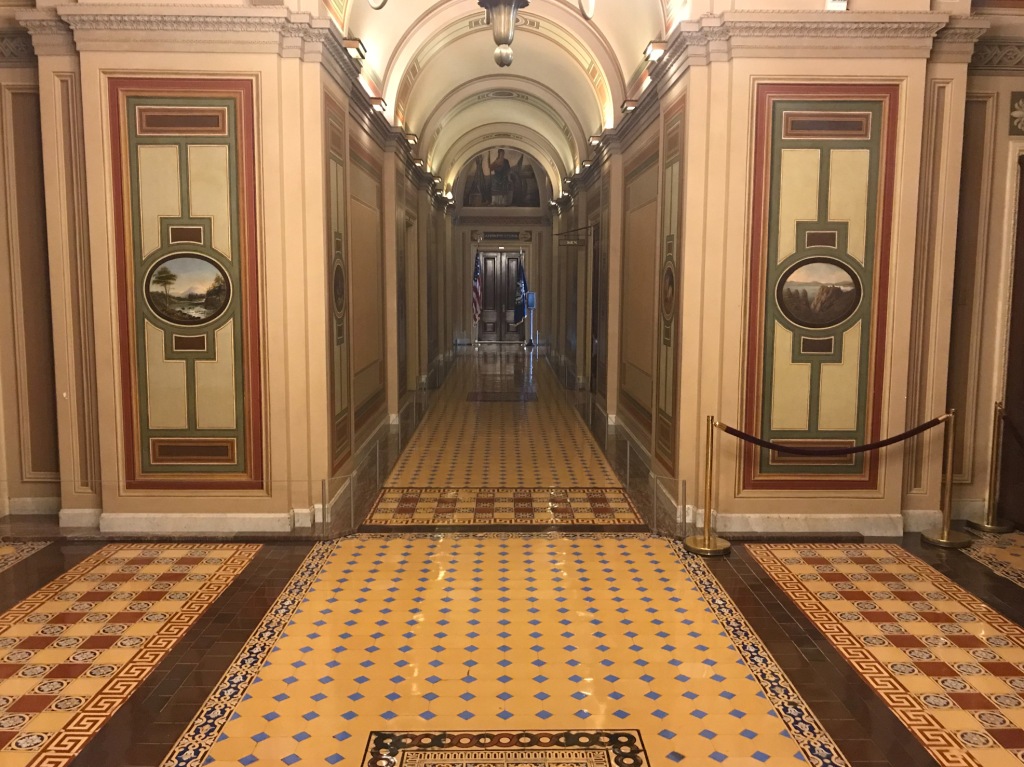
The other special tour took us to the Brumidi Corridors in the Senate wing. These corridors are part of the 1850s expansion of the Capitol. Constantino Brumidi led a team of artists in decorating these corridors with elaborate scenes of American landscapes, flora, fauna, and people. Brumidi used a technique called trompe l'oeil (fool the eye) to make the scenes appear three-dimensional rather than flat.


Brumidi also painted The Apotheosis of Washington in the canopy over the Rotunda. Brumidi has been called "the Michelangelo of the Capitol."

Below is a plaque that we walked by on one of our tours:


It says:
In memory of the passengers and crew of United Airlines Flight 93, whose brave sacrifice on September 11, 2001, not only saved countless lives but may have saved the U.S. Capitol from destruction.

Washington, DC Trip: Click here for the introductory post about our trip to Washington which lists all of the posts in this series.

Sunday, May 5, 2019

Skiing at Sugarloaf


Today was the last day of skiing for the season at Sugarloaf. Nancy and Susan were there. It was the first time that Nancy has skied on her birthday!


Thursday, November 1, 2018

Colorado Road Trip


We returned today from our road trip to Colorado. It was a great trip! We visited Brian in Boulder, reconnected with old friends along the way, and saw many interesting sights on both the drive out and the trip back.

Blog posts about our trip:
We were gone for 16 days, drove just over 5000 miles, and visited 14 states and one province.